§The free skeptic's guide

Every reason to doubt Bitcoin,
taken apart properly.

I called it digital tulips for years, so I'm not here to talk down to you. The thing I had wrong is the thing most people have wrong: Bitcoin isn't a risky asset to gamble on. It's a protocol, like the internet. It's already been chosen, it's built in layers, and it gets harder to stop every year. Below is every objection I used to throw at it, taken apart in full, with the real data, the charts and the sources so you can check every word yourself.

Don't take my word for any of it. Check it.

17 objections, in depth114 cited sourcesFree to read. Free to share.
01
Ponzi scheme

Bitcoin Is A Ponzi Scheme. Run It Through The Four Tests And Watch It Fail

Short answer. It fails all four of the SEC’s own Ponzi tests, and keeps coming back from crashes a fraud never survives.

I called Bitcoin a Ponzi scheme for years. Out loud, to anyone who'd listen. So I'm not here to scold you for thinking it. I thought it too.

The word gets thrown around because it sounds clever and final. "It's just a Ponzi." Conversation over.

A Ponzi cuts the inflows and dies, instantly and for good. Bitcoin has had its inflows run for the exits four times, and set a new all-time high after every one.

But a Ponzi scheme isn't a vibe. It's a specific kind of fraud with a specific shape, and the people whose job it is to catch them have written that shape down. So let's do the unglamorous thing and actually check.

The US Securities and Exchange Commission defines it plainly: "A Ponzi scheme is an investment fraud that pays existing investors with funds collected from new investors." 1

From that definition fall four fingerprints. There's a central operator running the books. There are returns promised, usually steady and high.

Old investors get paid with new investors' money rather than any real profit. And the whole thing collapses the moment new money dries up. The SEC says it straight: "When it becomes hard to recruit new investors, or when large numbers of existing investors cash out, these schemes tend to collapse." 1

Four tests. Let's run Bitcoin through all of them.

The SEC says a Ponzi has four fingerprints. Before you read on, have a go yourself. Does Bitcoin have each one?

  1. 1Is there a person or company running the books?

  2. 2Does it promise you a smooth, guaranteed return?

  3. 3Are early investors paid with new investors' money?

  4. 4When the new money stops, does it collapse for good?

Run the accusation through the SEC's own four tests and it fails on all four. SEC / Investor.gov [1]

You can probably guess how those land. No operator to arrest, because there's no chair. No promised return, just brutal public volatility.

No payouts to fake, because every coin sits on a public ledger anyone can audit with one command. 2 It's the fourth test, the collapse, where the gap becomes impossible to ignore.

In December 2008 the financial crisis spooked Madoff's clients, and roughly $7 billion in withdrawal requests landed at once. 4 He couldn't meet them, because the new money had stopped and there was never anything real underneath.

He confessed the next day and that was the end of it. 4 That's the defining feature of a Ponzi. Cut the inflows and it dies, instantly and for good.

Bitcoin has had its inflows cut violently, not once but repeatedly. In 2011 it fell from $31.91 to $1.99, a drop of nearly 94%. 5 In 2013 to 2015 it fell from $1,163 to $164, down about 86%. 5

In 2017 to 2018 it fell from $19,783 to $3,122, down 84%. 5 In 2021 to 2022 it fell from $69,044 to $15,476, down roughly 78%. 5

Four times the "new money" didn't just slow, it ran for the exits. Four times the obituaries got written. There's a website that has counted them: Bitcoin has been declared dead in the press hundreds of times. 6

And four times it recovered to a new all-time high. 5

Bitcoin's price since 2010 (log scale), the crashes a Ponzi could never fake
$1$100$10k$100k −93% −86% −84% −77%20122014201620182020202220242026 live crash peak low → a new high after every one

Bitcoin right now: loading… · live price via CoinGecko. Real weekly price data, drawn from 2010 to today.

Four times the new money fled and the obituaries got written (−94%, −86%, −84%, −78%). Four times Bitcoin found a floor and climbed to a new high. That is the one thing a Ponzi physically cannot do. Price history, peak/trough dates [5]

That is the thing a Ponzi physically cannot do. Madoff didn't come back from his collapse, because there was nothing real under it.

Bitcoin keeps coming back from collapses that would have ended any actual fraud, because there's a working network underneath that doesn't depend on the next sucker walking through the door. A scheme that pays old investors with new money has no floor. Bitcoin has found a floor and climbed off it every single time so far.

There's also the small matter of the books. Madoff's statements were fiction printed on letterhead.

Bitcoin's ledger is the opposite: every coin that has ever existed is recorded on a public chain that anyone can download and add up. The supply is capped at 21 million, and you don't have to take that on faith. Bitcoin Core ships a command, gettxoutsetinfo, that lets you audit the entire money supply yourself. 2 Try asking Bernie Madoff for read access to his books.

Now, let me concede what's fair, because I'm not interested in selling you anything.

Bitcoin is genuinely volatile. Those drawdown numbers are real, and if you bought at the top of any of those cycles you had a miserable couple of years.

It is also young. Gold has been money for thousands of years; Bitcoin has been around since 2009. A shorter track record means more uncertainty, and anyone who tells you the recoveries are guaranteed to keep happening is guessing.

Past behaviour is not a promise.

But "volatile and young" is a completely different claim from "Ponzi scheme." One is an honest description.

The other is a specific accusation of fraud that, when you actually run it through the SEC's own four tests, fails on every count. No operator. No promised return. No old-paid-with-new. And the opposite of a one-way collapse.

No operator. No promised return. No old-paid-with-new. And the opposite of a one-way collapse.

Don't take my word for any of it. The drawdown dates are in the price history. The supply audit is a command you can run.

The dead-Bitcoin count is a list you can scroll. That's rather the point of the whole thing. You're not asked to trust. You're invited to check.

Sources (6)
  1. Ponzi Scheme · U.S. SEC, Investor.gov
  2. How is the 21 Million Bitcoin Cap Defined and Enforced? · Jameson Lopp
  3. The Bitcoin Standard Quotes · Saifedean Ammous (Goodreads)
  4. Bernie Madoff's Ponzi Scheme: How It Worked and Collapsed · LegalClarity
  5. Bitcoin Drawdown History: Every Major Crash & Recovery
  6. Bitcoin Obituaries

02
Just speculation

It Makes Nothing, It Pays Nothing: The Greater Fool Objection

Short answer. Flipping it weekly is a punt. Holding a money no one can print isn’t greed, it’s refusing to watch your savings melt.

When I was a sceptic, this was my closing argument. I'd lean back, fold my arms, and deliver it like a verdict. "Bitcoin makes nothing. It pays no dividend, no rent, no interest. The only way you make money is to sell it to some other mug who pays more than you did. That's not investing. That's a game of musical chairs, and one day the music stops."

I felt very clever saying it. Trouble is, I was half right, which is the most dangerous thing to be.

Gold makes nothing. Cash makes nothing. We still call them money. 'It produces nothing' was never the test.

The half I got right, and most Bitcoiners skate over it: loads of people genuinely do just gamble on the price. They buy on a Tuesday hoping to sell richer on a Friday, watch the chart like it owes them money, and have no idea what they actually own.

That's speculation, and it has a proper name. The greater fool theory describes buying an overvalued asset not because it's worth the price, but because you expect to offload it to an even greater fool who'll pay more 1.

It only works while fresh fools keep showing up. When they stop, the price falls back towards what the thing is actually worth, which can be nothing 1. If that's how you're treating Bitcoin, the criticism lands. You are gambling.

Here's where my old argument falls apart.

The claim underneath "it makes nothing, it pays nothing" is that a thing must produce an income to be worth holding. Sounds reasonable. Now apply it to the money in your pocket.

A ten pound note pays no dividend. Gold in a vault pays no interest and produces precisely nothing; it just sits there being gold.

The balance in your current account doesn't manufacture anything either. By the "it makes nothing" test, every form of money ever used fails. That's your first clue the test is measuring the wrong thing.

Money's job was never to produce value. Its job is to store it. You did the producing already, when you went to work; money is just where you park that effort until you need it.

Lyn Alden, in her book Broken Money, frames money as the most saleable good in a society, the thing everyone will reliably take off your hands, and an ideal money carries your value across both distance and time 2.

A dividend-paying share is a productive asset. Money is a different tool for a different job. Criticising money for not paying a dividend is like criticising a fridge for not cooking your dinner.

Then there's the sharper version of my old line. "But someone else has to want it for you to get anything back." Yes. And that isn't a flaw in Bitcoin. That is the definition of money.

A pound only works because the next person accepts it. So does a dollar, a euro, a gram of gold, a tin of beans in a barter economy.

Money is a shared, transferable claim, an agreement that this token can be passed on. No money anywhere has ever had value without someone else being willing to take it next.

When I said "you just sell it to the next person," I thought I'd found Bitcoin's fatal weakness. I'd actually described what money is.

No money anywhere has ever had value without someone else being willing to take it next.

So if "makes nothing" and "needs a next buyer" are true of all money, they tell us nothing useful. What actually separates good money from bad? One question, and it's the right one to be a sceptic about: while you're holding it, can someone quietly make more of it and dilute what you've got?

This is where the three really differ.

Cash (fiat)GoldBitcoin
Pays an income just for holding?NoNoNo
Can the supply be increased?Yes, at will, by central banksSlowly, ~1.5-2% mined a yearNo, capped at 21M in code
Why does it hold value?Law and trust in the issuerScarcity and 5,000 years of acceptanceFixed scarcity plus growing acceptance
Track record on debasementUSD has lost 96%+ since 1913Held value over centuriesNo supply expansion possible by design
The 'it makes nothing' test fails on every kind of money. The real difference is whether someone can inflate the supply while you hold it. Sources [3][4][5]
Sources (6)
  1. Greater fool theory
  2. Lyn Alden, Broken Money
  3. Supply, World Gold Council
  4. Bitcoin Halving / 21 million supply
  5. The dollar has lost over 96% of its purchasing power since 1913 (AEI, BLS CPI)
  6. Saifedean Ammous, The Bitcoin Standard
03
Backed by nothing

Bitcoin Is Backed By Nothing. No. It's Backed By Energy. The Pound Is The One Backed By Nothing.

Short answer. Bitcoin is backed by real energy and a fixed supply. The pound is the one backed by nothing but a broken promise.

I used to say it like it settled the argument. "Bitcoin's backed by nothing." Job done, next.

I had it exactly backwards. Bitcoin is backed by something you can measure in the real world. The pound in your pocket is the one backed by nothing but a promise. Let me show you both.

You can copy Bitcoin's code in five minutes. You cannot copy the energy that secures it, or the seventeen years of it already spent. That is the backing, and it is the one thing a copycat can't reprint.

Start with Bitcoin, the bit I got wrong. It is not backed by a company, a founder, or a marketing budget. It is backed by energy.

The network is secured by computers all over the world burning real electricity to compete, measured in hashrate. As I write this it sits around 889 exahashes per second 7. That is 889 followed by 18 zeros, guesses, every second, all of it costing real money in real watts.

To rewrite Bitcoin's history you'd have to out-muscle all that hardware and all that power at once, and pay for it. That cost is the backing. It is not a promise anyone can break. It is a bill an attacker physically cannot afford.

That cost is the backing. It is not a promise anyone can break.

Here is the part that turned me round. You can copy Bitcoin's software in five minutes; the code is open, anyone can fork it.

But you cannot fork the energy. You cannot copy seventeen years of electricity already spent, the warehouses of machines, the grid connections, the millions of computers checking every transaction night and day.

That is why a "better Bitcoin" never sticks. A fresh copy of the code is just a PDF with big dreams. Energy anchors Bitcoin to physical reality in a way no other digital money ever has.

On top of the energy sits a rule nobody can move. There will only ever be 21 million bitcoin. Not because someone promised, but because it is written into the code every user runs, and you can audit the entire supply right now from your sofa.

Saifedean Ammous puts it plainly in The Bitcoin Standard: "No matter how many people use the network, how much its value rises, and how advanced the equipment used to produce it, there can only ever be 21 million bitcoins in existence" 8. Energy you have to burn, plus a cap no president can touch. That is the backing.

Now turn the question on the pound.

Pull a £20 note out of your wallet and read it. "I promise to pay the bearer on demand the sum of twenty pounds." Pay you in what?

Once you could march into the Bank of England and swap that note for gold. Try it now and they'll hand you... another note. It's a promise to pay you a promise.

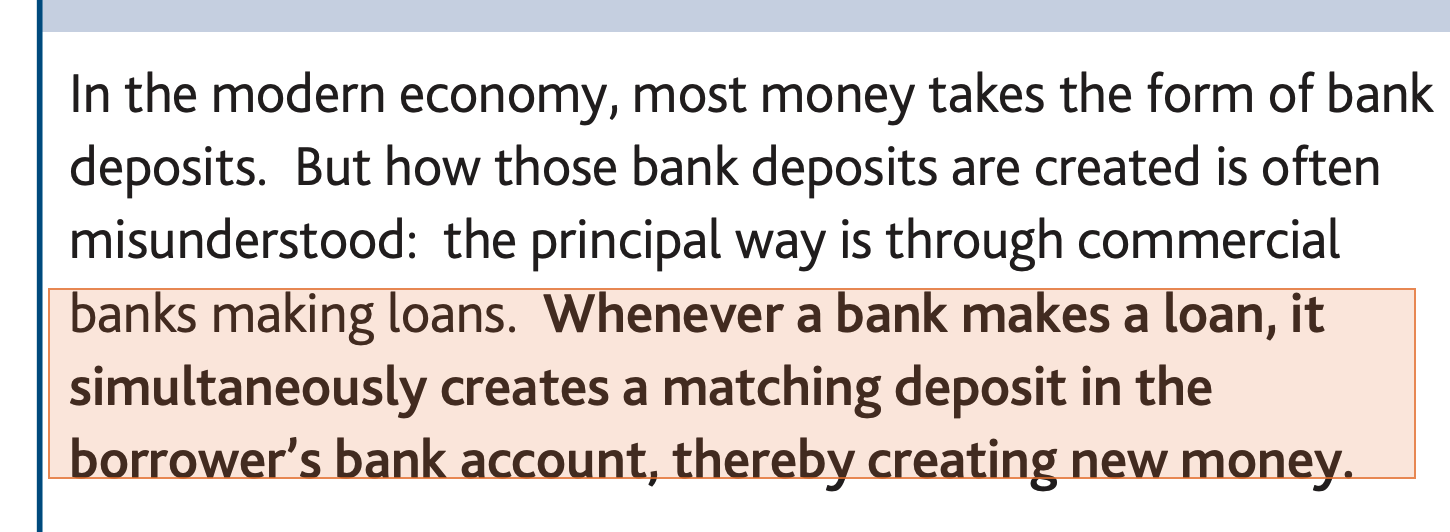
Worse, almost none of it was ever "printed" at all. The Bank of England's own economists have spelled it out: around 97% of the money in the economy is created by commercial banks, out of nothing, the moment they make a loan.

Don't take my word for it. Take theirs.
Bank of England paper 'Money creation in the modern economy': whenever a bank makes a loan it creates a matching deposit, new money.
The Bank of England's own economists, in black and white. Highlighted: when a bank makes a loan it creates a matching deposit, brand-new money out of nothing. That is where roughly 97% of the pounds in circulation come from. Read the Bank of England paper →

The day before you sign a mortgage, that money does not exist. The bank types it into your account.

So when someone says Bitcoin is "conjured out of thin air," they have the wrong money. It's the pound that's conjured. Bitcoin is the one you have to burn energy to make.

So when did the pound stop being backed by something real? Not one dramatic day. Two.

The first was 21 September 1931. Britain was haemorrhaging gold as foreign holders pulled their money out of London, and the Bank of England simply gave up the link. Parliament passed the Gold Standard (Amendment) Act and that was that 1. The pound floated free of metal and never went back.

The second I find genuinely funny, in a grim way. On 15 August 1971, Richard Nixon went on American television and announced he had "directed Secretary Connally to suspend temporarily the convertibility of the dollar into gold" 2.

Temporarily. That was 55 years ago. The Federal Reserve's own history page records the moment and notes the dollar has not been convertible to gold since 3.

His Treasury Secretary, John Connally, had reportedly told him in private weeks earlier, "We may never go back to it. I suspect we never will" 4. They knew. "Temporary" was the word for the public.

Since 1971, then, every pound and every dollar has been backed by exactly one thing. A government's promise not to print too much of it.

So how's that promise holding up? The fair point first: a promise from a stable government with courts and a central bank is not nothing. It's why you can buy a coffee without weighing out silver. Fiat money works as a day-to-day tool. I'm not pretending otherwise.

But "backed" should mean it holds its value. Look at what the promise delivered.

According to US Bureau of Labor Statistics data, one 1971 dollar buys what about 12 cents bought back then. Prices are up 722% 5.

The pound did worse. Using the Office for National Statistics composite price index, £1 from 1971 now needs £18.35 to buy the same basket, a cumulative 1,735% rise in prices 6. Roughly 95p of every pound's purchasing power, gone.

What's left of a 1971 pound, dollar, and bitcoin
US dollar~12% left (88% gone)
UK pound~5% left (95% gone)
Bitcoin (21M cap)100% (0% inflatable)
The promise 'not to over-print' met reality: US prices +722% since 1971, UK prices +1,735%. Bitcoin's supply cannot be inflated by anyone. BLS / ONS [5][6]

That's not a wild market or a crash. That's the system working as designed. Slow, steady, every single year. The promise not to over-print gets broken a little each year, and they call it the inflation target.

This is the bit that flipped me. I went looking to prove Bitcoin was the nonsense and found the pound resting on a promise with a 95% failure rate.

So compare the two honestly. A pound is backed by a promise from people who can create more pounds whenever it suits them, and who have quietly created enough to wipe out 95% of its value in my lifetime.

Bitcoin is backed by burned energy and a supply cap that no president, no central banker, no committee can move. One is a promise that gets broken a little every year. The other is physics.

What backs the pound
  • A promise not to over-print
  • ~97% of it created by banks as loans, from nothing
  • The gold link was cut in 1971
  • More can be made at will, by decree
  • Track record: ~95% of its value gone since 1971
What backs Bitcoin
  • Real energy, burned to secure every block (~889 EH/s)
  • You can fork the code, you can't fork the energy
  • A 21M cap written in code you can audit yourself
  • No president or committee can print more
  • Track record: 0% of its supply inflatable, ever
Backed by nothing is the wrong way round. The pound rests on a promise that's been broken a little every year. Bitcoin rests on energy you have to spend and a cap nobody can move. BoE / BLS / ONS / CoinWarz [5][6][7]

So I'd flip the question. "Backed by nothing" was never really about backing. It was about whether you trust the issuer to show restraint, and fiat issuers have a 55-year track record of having none.

Don't take my word for it. The inflation numbers are published by the BLS and the ONS. The hashrate is on a dozen public sites. The 21 million is in code anyone can read.

Check it yourself. That's the whole point. With Bitcoin you don't have to take anyone's promise. With the pound, the promise is all you've got.

Sources (8)
  1. Going off gold · The National Archives (UK)
  2. Address to the Nation Outlining a New Economic Policy: "The Challenge of Peace," 15 August 1971 · The American Presidency Project (full Nixon speech text)
  3. Nixon Ends Convertibility of U.S. Dollars to Gold · Federal Reserve History
  4. Nixon shock (Connally "we may never go back to it") · Wikipedia, citing Garten, Three Days at Camp David
  5. $1 in 1971 → 2026 (US BLS CPI data) · in2013dollars
  6. £1 in 1971 → 2026 (UK ONS composite price index) · in2013dollars
  7. Bitcoin Hashrate Chart (888.75 EH/s, 19 June 2026) · CoinWarz
  8. The Bitcoin Standard, Saifedean Ammous (2018), on the 21 million cap
04
No utility

But Bitcoin Doesn't Do Anything Is the Whole Point

Short answer. Money’s one job is to hold value with a supply you can trust. "No other use" is the feature, not the flaw.

I used to think this was the knockout blow. Gold ends up in wedding rings, dental crowns and the gold-plated connectors inside your phone. Bitcoin just sits there. It doesn't conduct electricity or look nice round your neck. So gold has "real" value and Bitcoin has none, and that's that.

Peter Schiff has built half a career on this line. "I can't make jewelry without physical gold, I can't conduct electricity without physical gold," he says, while Bitcoin "has no physical form, no industrial application, and no yield" 1.

The money question was never 'what else is it good for'. It's 'can anyone quietly make more while you're holding it'.

It sounds airtight. It's the most common reason I hear from people who haven't looked closely. I was one of them.

Then someone made me think about what money is actually for, and the argument turned inside out.

What is the job?

Money has three jobs, usually listed in this order: a store of value, a medium of exchange, and a unit of account.

Vijay Boyapati's "The Bullish Case for Bitcoin" makes the point that modern economics is obsessed with the medium-of-exchange role and has half-forgotten the rest. Through the 20th century, states monopolised money and steadily wrecked its ability to store value, leaving people believing money is mainly the thing you spend 2.

But money monetises in stages, and the store-of-value role comes first. Only once something is a deeply established store of value does it become a good medium of exchange, and only then a unit of account 2.

So the question isn't "what else can you do with it?" It's "how good is it at the one job?"

And the property that matters most there is a trustworthy, predictable supply. If your money can be quietly inflated, it fails as a store of value no matter how shiny it is.

Here's where the jewellery argument backfires.

Gold's other uses don't strengthen it as money. They make its supply impossible to pin down. Roughly 220,000 tonnes of gold have ever been mined, and that above-ground stock grows by around 1.8% a year through new mining 3.

That slow growth is genuinely impressive, the best of any physical commodity, which is why gold won the money job for thousands of years. Its stock-to-flow ratio sits in the mid-60s, meaning the world holds about 60-plus years of current production in existing stock 4. Hard to inflate. Brilliant.

But layer the "real uses" on top. Jewellery, electronics, dentistry and aerospace all consume gold, pulling at the float by an amount nobody can measure precisely.

When the price rises, more recycling comes back, and mine output flexes too. In Q1 2026, total gold supply rose 2% year on year, partly off a 5% jump in recycling 5. The float you're trying to store value in is tugged from both ends by industries that have nothing to do with money, and you can't get a clean number for any of it.

The "extra utility" Schiff is so proud of is a source of unpredictability. For a store of value, that's a bug.

This is the flip Jack Mallers and others have hammered home in the Schiff debates: gold's supply is elastic, it expands through human innovation and price response, and that makes it a less reliable store of value, not a more reliable one 6.

The "extra utility" Schiff is so proud of is a source of unpredictability. For a store of value, that's a bug.

Bitcoin removed the bug by removing the utility.

Bitcoin doesn't do anything else, and that is the feature. Nothing competes for it. No jeweller, no dentist, no chip foundry is bidding for the supply, so the only demand is monetary demand, and the supply is fixed by code rather than by mining economics.

Gold
  • Above-ground stock ~220,000 tonnes
  • Supply grows ~1.8% a year
  • Float blurred by jewellery, electronics, recycling
  • Future supply is estimated, never exact
Bitcoin
  • Hard cap 20,999,999.97 BTC, fixed in code
  • Issuance halves every ~4 years
  • No industrial demand competing for supply
  • Future supply known exactly out to 2140
Both are scarce. Only one is scarce in a way you can verify to the last unit. World Gold Council / Bitcoin Core

You don't have to take my word for that, and you shouldn't. Go and read it.

Bitcoin Core defines the supply ceiling in the source file src/consensus/amount.h. The constant MAX_MONEY is set to 2,099,999,997,690,000 satoshis, just under 21 million bitcoin 7.

It is enforced by every node validating every block. You can check exactly how many bitcoin exist today and exactly how many will exist in the year 2140, which is more than you can honestly say about how much gold is above ground right now 7.

That's the difference between scarce and verifiably scarce. Gold's 1.8% is a careful estimate. Bitcoin's schedule is known, today and in a hundred years.

Lyn Alden's framing is that Bitcoin enforces a hard cap producing verifiable digital scarcity, with issuance dropping predictably through the halvings every four years 8. No survey, no recycling guesswork, no industrial demand pulling at the edges.

So the objection just dissolves.

"Bitcoin does nothing" is true. It's also the answer to its own complaint.

Money's core job is to hold value reliably, and the property that delivers that is a supply you can trust and predict. Gold's other uses make its supply harder to predict. Bitcoin having none makes its supply perfectly predictable.

I came at this trying to dunk on Bitcoin with the jewellery line. I left realising I'd been describing gold's weakness and calling it a strength. The thing that does "nothing" turns out to do the one thing money is supposed to do, and it does it better.

The thing that does "nothing" turns out to do the one thing money is supposed to do, and it does it better.
Sources (8)
  1. Peter Schiff's Bitcoin "no intrinsic value / no industrial application" critique
  2. Vijay Boyapati, The Bullish Case for Bitcoin (Part 3)
  3. World Gold Council · Gold Market Primer: Market size and structure (~220,000t above ground; stock grows ~1.8%/yr)
  4. Lyn Alden · Why Gold and Bitcoin are Popular / stock-to-flow ~60+ years
  5. World Gold Council · Gold Demand Trends: Q1 2026 (supply +2% y/y, recycling +5%)
  6. Jack Mallers vs Peter Schiff · gold's elastic supply makes it a weaker store of value
  7. Bitcoin Core source code · MAX_MONEY = 21000000 * COIN in src/consensus/amount.h (the 21M cap, in the code every node runs)
  8. Lyn Alden · Bitcoin's hard cap, verifiable scarcity and predictable halving issuance
05
They’ll change the 21M cap

The Developers Could Just Raise It. Why They Can't

Short answer. Tens of thousands of nodes enforce the 21 million. Change it and you’ve just made a copy nobody accepts.

I used to think the 21 million cap was a marketing gimmick. A round number Satoshi picked because it sounded scarce, one the people writing the software could quietly delete whenever they fancied printing themselves a few million more.

It was one of my biggest reasons for not taking Bitcoin seriously. If a developer can change it, it's no scarcer than a central bank's promise.

Bitcoin Cash forked off in 2017 with 'better' rules and most of the industry behind it. The market priced it at a third of a percent of Bitcoin.

Then I looked at how the rule is enforced. I had the whole thing backwards.

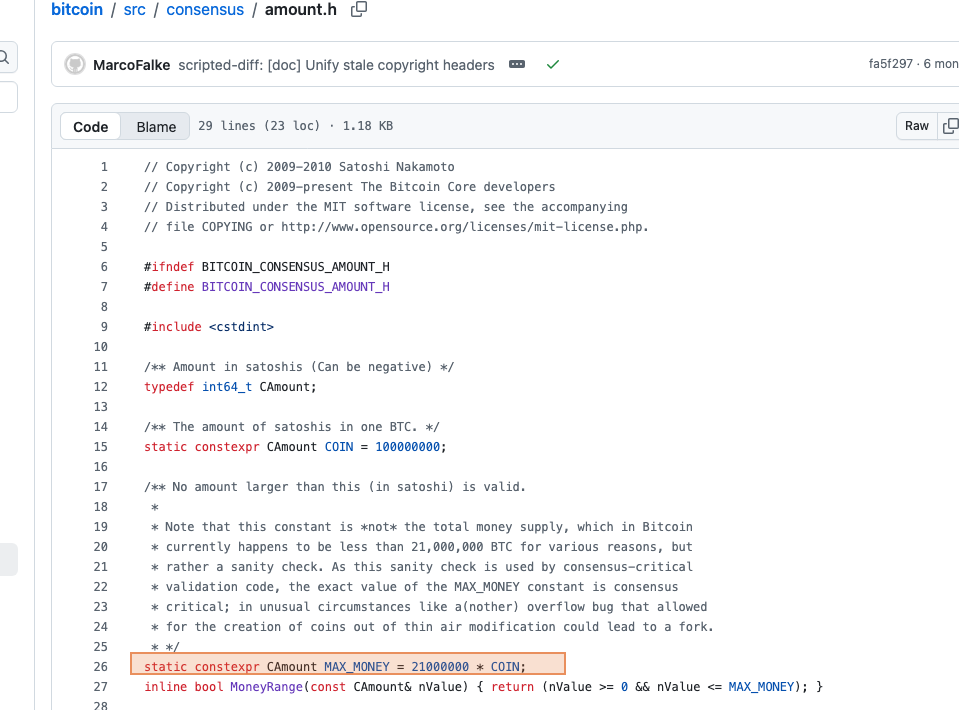
The easy half first. Yes, the cap is "just a number in the code." Open Bitcoin Core's source and it sits in a file called consensus/amount.h, defined as MAX_MONEY = 21000000 * COIN 1.

Don't take my word for it. Here's the actual code.
The Bitcoin Core source file src/consensus/amount.h, with line 26 highlighted: static constexpr CAmount MAX_MONEY = 21000000 * COIN.
This is the real file, on Bitcoin's public source code. Line 15 sets a COIN to 100,000,000 satoshis. Line 26 (highlighted) is the whole 21 million rule: MAX_MONEY = 21000000 * COIN. That one line is the cap, sitting in the open for anyone to read, and every node checks it on every block. See it on GitHub for yourself →

Because the block reward halves every four years, the supply actually tops out a hair under that, at 2,099,999,997,690,000 satoshis, but the principle holds. It is a line of code.

And anyone, including me, could fork the repository this afternoon and change that line to 42 million. Nobody would stop you. There's no password.

Here's what the objection misses entirely. Changing the number in your copy of the software does precisely nothing to the network.

Bitcoin isn't run by the developers. It's run by everyone who downloads the software and validates the rules for themselves. Every one of those machines is a node, and each node independently checks every block against its own copy of the rulebook.

As I write this there are roughly 23,000 reachable nodes online, spread across more than 170 countries 2, and many thousands more behind firewalls where the public crawlers can't see them. None of them trust the developers. Each one checks.

So picture a developer shipping a new version that raises the cap. They publish it. They write a glowing blog post.

And then every node still running the real rules looks at the first block that creates a 22-millionth coin, sees a transaction that violates MAX_MONEY, and rejects it as invalid. Not "flags for review." Rejects.

The block doesn't exist as far as that node is concerned. The chain with the bigger cap is now a separate network the rule-following nodes will never speak to.

You haven't raised Bitcoin's cap. You've made a different coin that nobody runs.

Verify-don't-trust isn't a slogan, it's the actual mechanism. Nobody takes the developer's word for the supply, because the software checks it on every single block.

If that sounds like a nice theory, the good news is we ran the experiment. For real, with billions of dollars and most of the industry on one side.

Between 2015 and 2017 Bitcoin went through what Jonathan Bier called the Blocksize War in his book of the same name. The fight wasn't about the 21 million cap, but it was the same kind of fight: a push to change one of Bitcoin's core rules, in this case raising the block size limit.

The people pushing it were not fringe. They had most of the mining hash power, the largest companies, the exchanges, and in May 2017 fifty-odd of those companies signed the New York Agreement to force the change through 3.

By every assumption the objection relies on, they should have won. The "important people" wanted it.

They lost. A scrappy counter-move called the User Activated Soft Fork, BIP148, set a date of 1 August 2017 on which nodes would start rejecting any block that didn't follow the original rules 3. It put the ordinary node-runners, not the miners, in charge of the deadline.

Faced with their blocks being orphaned by the very users they served, the miners capitulated. SegWit activated on the original chain on 24 August 2017 3. The big-block faction took their rule change and forked off on 1 August to form a separate coin, Bitcoin Cash 4.

Which brings us to the visual, the cleanest answer to "the developers could just change it" I know of. Bitcoin Cash is the real-world example of changing a rule against the will of the node-runners.

So how's the breakaway coin doing? On launch it traded around 0.1 to 0.5 BTC. As I write this in June 2026, one BCH is worth about 0.0031 BTC 5. The market didn't reward the chain with the "improved" rules. It abandoned it.

BCH priced in BTC (log scale) 0.20 Aug 2017 0.28 peak Dec 2017 0.04 2019 0.012 2021 0.005 2023 0.0031 Jun 2026
Bitcoin Cash launched with 'bigger blocks' and a chunk of the industry behind it. Priced against Bitcoin, the market gave its verdict: down 99%. Price ratio, exchange data

The lesson Bier draws is blunt, and it's the bit that changed my mind: the side with the money, the miners and the corporate logos lost to the side with the nodes. As he puts it, the small-blockers won "not because they had more resources, but because they understood that the users were sovereign."

So when someone tells me the cap is arbitrary and the devs could just raise it, I now hear two claims smushed together. The first, that it's a number in a file, is true and irrelevant.

The second, that the developers could enforce a change, is flatly false, and we have the receipts. Developers propose. Miners produce blocks. Neither rules. The tens of thousands of people running nodes do, by the simple act of refusing to accept anything that breaks the rules they signed up for.

Don't take my word for it. Download a node, let it sync, and try to spend a coin that shouldn't exist. Your own machine will tell you no. That's the whole point.

Sources (5)
  1. Bitcoin Core source · `src/consensus/amount.h` (MAX_MONEY = 21000000 * COIN)
  2. Bitnodes · Reachable Bitcoin Nodes (≈23,000 nodes, 170+ countries)
  3. Bitcoin Magazine · "Bitcoin Independence Day: Luke Dashjr On The Lessons From SegWit" (BIP148 UASF, 1 Aug 2017, New York Agreement, SegWit activated 24 Aug 2017)
  4. Bitstack · "Blocksize War: The essence of the biggest conflict in Bitcoin history" (BCH hard fork at block 478,559, 1 Aug 2017)
  5. CoinGecko · BCH to BTC ratio (current ≈ 0.0031 BCH/BTC, June 2026; all-time-high tracked 0.2846)
06
Used by criminals

Bitcoin Is What Criminals Use. The Worst Money A Smart Crook Could Pick

Short answer. Cash is the criminal’s favourite. Under 1% of crypto is illicit, and a public ledger is the worst tool a smart crook could pick.

I used to nod along to this one. Of course criminals use Bitcoin. Ransom notes ask for it, the dark web runs on it, and every news story about a drug bust seems to have a Bitcoin logo slapped on the thumbnail.

It felt obvious. So obvious I never actually checked it.

Cash is still the criminal's favourite. The old system launders an estimated 2-5% of global GDP a year. Crypto's illicit share is under 1%, and most of that isn't even Bitcoin.

Then I checked it. And the numbers don't say what I assumed they said.

The real part first, because there is one. Criminals do use Bitcoin. Some scams, some ransomware, some sanctions evasion.

That happens, and pretending otherwise would be daft. The question isn't whether any crime touches Bitcoin. It's whether Bitcoin is meaningfully a criminal's tool, especially compared to the money we already use every day without blinking.

Start with the share. Chainalysis publishes a Crypto Crime Report every year, and they trace this stuff for a living, including for law enforcement. Their latest figure: illicit activity is "below 1%" of all attributed crypto transaction volume 1.

Under one percent. The other ninety-nine-plus is people buying, selling, saving, sending money to family, speculating, paying for things. The crime is the rounding error, not the headline.

Now hold that up against the old system. The United Nations Office on Drugs and Crime estimates that between 2% and 5% of global GDP is laundered every year, roughly 800 billion to 2 trillion US dollars 2.

That's the existing financial system, the banks and the cash, doing the laundering. By the UN's own range, the traditional world launders a bigger slice of itself than crypto does, and it does it in the trillions.

There's a worked comparison below if you want it as a picture rather than a paragraph.

How much of each system is dirty money?
Crypto (% of transaction volume)<1%
Traditional finance (% of global GDP)2-5% (~$800bn-$2tn)

And 84% of crypto's small illicit slice is now stablecoins, not Bitcoin.

Crypto's illicit share sits below 1% of volume. The traditional financial system launders an estimated 2-5% of global GDP every year. Chainalysis 2026 / UNODC

Here's the bit that should really end the argument. Even within that under-1%, it isn't mostly Bitcoin any more. Chainalysis says stablecoins now account for 84% of all illicit transaction volume 1.

And what is that illicit crypto, actually?
Stablecoins (dollar-pegged tokens)84%
Bitcoin and all other crypto combined16%

So of crypto's already sub-1% illicit slice, more than four-fifths isn't Bitcoin at all.

Within the under-1% of crypto volume that is illicit, stablecoins are 84% of it. Bitcoin is a small piece of a small piece, and shrinking. Chainalysis 2026 Crime Report [1]

Stablecoins are dollar-pegged tokens, not Bitcoin. So when someone says "Bitcoin is what criminals use," the on-chain data says the criminals have largely moved to something else. The slogan is out of date as well as out of proportion.

Why would they move? Same reason anyone uses a dollar token over a volatile asset: it's a stable dollar that doesn't lurch 5% while you're trying to move it.

Criminals are not idiots. They optimise like everyone else.

Which brings me to the part I got most wrong.

I assumed Bitcoin was good for crime because I assumed it was anonymous. It isn't. Bitcoin is pseudonymous, not anonymous, and that gap is enormous.

Every transaction is written to a public ledger that anyone on earth can read, forever. Your name isn't on it, but a permanent, tamper-evident trail of every move you ever made is. The moment anyone links one address to your identity, and exchanges with ID checks do exactly that, your entire history unspools backwards and forwards.

Cash leaves no trail. Bitcoin is nothing but trail.

If you were a genuinely smart criminal, this is close to the worst money you could choose.

If you were a genuinely smart criminal, this is close to the worst money you could choose. You'd be committing your crimes onto a global, permanent, searchable database and handing investigators the evidence in advance.

Don't take my word for it. Look at what actually happens. In February 2022 the US Department of Justice seized more than 94,000 bitcoin tied to the 2016 Bitfinex hack, worth about 3.6 billion dollars at the time, the largest financial seizure in the department's history 3.

How? They followed the coins. The thieves tried to launder the haul through thousands of transactions, and investigators traced every hop on the public blockchain until they reached the wallets, then the people 34. The same ledger the criminals thought protected them is the thing that convicted them.

That's not a one-off. The Silk Road takedowns, the ransomware clawbacks, the sanctions tracing the UN and others now lean on, all of it works because the ledger is open. Try doing that with a suitcase of fifties.

So let's be honest about what's really happening. The complaint "criminals use it" gets aimed at Bitcoin and almost never at cash, even though cash is the untraceable bearer instrument criminals have always preferred.

Nobody proposes banning the 50-pound note because drug dealers like it. We accept that a useful tool gets misused at the margins, and we don't condemn the tool for it.

Apply the same fairness to Bitcoin and the objection mostly evaporates. Under 1% illicit. Most of that not even Bitcoin. A public ledger that has helped law enforcement recover billions. A traditional system the UN says launders up to 2 trillion dollars a year by comparison.

The story I'd been told had it backwards. Bitcoin isn't the criminal's dream. It's the investigator's.

I had it the wrong way round, and the data, which you can go and read yourself, is what turned me around.

Sources (4)
  1. 2026 Crypto Crime Report Introduction · Chainalysis
  2. Money Laundering Overview · United Nations Office on Drugs and Crime (UNODC)
  3. Office of Public Affairs · Two Arrested for Alleged Conspiracy to Launder $4.5 Billion in Stolen Cryptocurrency (Bitfinex seizure) · US Department of Justice
  4. How DOJ Tracked Down the Bitcoin Stolen in the Bitfinex Hack · TIME
07
Boiling the oceans

Bitcoin Is Boiling the Oceans. Waste Compared to What?

Short answer. Miners chase the cheapest power, which is the wasted kind, and the data points to Bitcoin being a net positive.

I used to nod along with this one. Of all the anti-Bitcoin arguments, "it wastes a colossal amount of electricity and it's cooking the planet" felt like the unanswerable one. It's the objection I was most reluctant to let go of, and the honest answer is more hedged than either side usually admits.

Concede the real part first. Bitcoin uses a lot of electricity. That isn't propaganda, it's the whole design.

Bitcoin uses less power than the banking system it competes with, less than the gold it's compared to, and less than the gadgets sitting idle in American homes.

Mining deliberately burns energy so that rewriting the ledger costs more than it's worth, which is what makes the network expensive to attack. The Cambridge Centre for Alternative Finance, the most cited neutral source on this, put the network's 2024 consumption at roughly 138 terawatt-hours a year, about 0.5% of global electricity 1.

Cambridge's live index has at times shown higher figures depending on assumptions, and a few critics argue even that understates it 4. So nobody serious is claiming the number is small. It isn't.

The question I should have asked years earlier is the obvious one. Waste compared to what?

"Waste" is a moral word doing the work of a measurement. Every use of electricity could be called waste by someone who doesn't value the output.

The interesting question is whether what we're buying with the energy is worth it, and how it stacks up against the things we never complain about.

So here's some context. A 2021 analysis by Galaxy Digital, using IEA emissions conversions, estimated the traditional banking system at around 264 TWh a year and gold mining at around 241 TWh, against Bitcoin's roughly 114 TWh at the time 2.

Galaxy is a Bitcoin-friendly firm and those numbers are a few years old, so treat them as a ballpark. But even allowing for that, the order of magnitude is telling. The two systems Bitcoin is most often compared to, banking and gold, are not obviously cheaper on energy.

Closer to home, US households leak an estimated 64 billion kWh a year just from devices sitting idle on standby, the always-on glow of plugged-in electronics doing nothing 3. Nobody writes furious op-eds about the gaming console in sleep mode or the always-warm tumble dryer. The outrage is selective.

Estimated annual electricity use
Banking system~264 TWh
Gold mining~241 TWh
Bitcoin (2024, Cambridge)~138 TWh
US household standby / idle waste~64 TWh
Bitcoin's footprint is real but not uniquely large next to the systems it competes with. Banking and gold figures are 2021 ballpark estimates; Bitcoin's is the 2024 Cambridge figure. Cambridge CCAF [1] / Galaxy [2] / NRDC [3]

None of that proves Bitcoin's energy use is justified. It shows that "uses a lot of electricity" is true of almost everything we've decided is worth having, and singling out one system needs a stronger argument than the raw TWh figure.

Then there's the question of what kind of electricity. The picture most people carry around is coal smokestacks running flat out for magic internet money. That picture is out of date.

Cambridge's April 2025 industry report, based on a survey of 49 mining firms covering roughly 48% of the network, found that 52.4% of mining's energy now comes from sustainable sources, 42.6% renewables plus 9.8% nuclear 1. Coal, the villain of the story, has collapsed from 36.6% in 2022 to 8.9%. Natural gas is now the single biggest input at 38.2% 1.

The caveat: that's a self-reported survey with a margin of error, so don't treat 52.4% as decimal-perfect. But the direction is clear, and it's the opposite of the cliché.

A Bitcoin miner is an unusual kind of electricity customer.

The reason for the shift is the genuinely interesting bit. A Bitcoin miner is an unusual kind of electricity customer. It can sit anywhere, it can switch off in seconds, and it doesn't care whether the power arrives at midday or 3am.

That makes it a buyer for energy nobody else can use: the hydro plant in the middle of nowhere with no grid connection, the wind farm producing more than the line can carry, and most strikingly, the gas that oil wells flare off and burn into the sky for nothing.

Picture a baker who never knows how much bread to make, so half of it ends up in the bin. Then a buyer turns up who will take every loaf he can bake, every day, forever.

So he builds a bigger oven and opens in the next village. The waste becomes a thriving business. That is what a miner does for a remote dam or an overbuilt solar farm: it turns the wasted half into income, and that income is what funds more clean energy getting built in the first place.

How mining turns wasted power into more clean energy
1
Energy gets wastedA wind farm overproduces, a remote dam has no grid, a gas well flares methane into the sky. Power with no buyer.
2
A miner shows upIt buys the excess, anywhere, any time, and switches off the moment the grid actually needs the power.
3
So more gets builtA guaranteed buyer makes the project pay. The waste becomes income, and that income funds more clean energy. Abundance, not scarcity.
The baker builds a bigger oven once someone takes every loaf. Mining is that buyer for stranded and overbuilt energy, which is exactly what gets more of it built. Cambridge CCAF / energy-mining research [1][5][6]

That flared gas is mostly methane, a far worse greenhouse gas than the CO2 you get from burning it. A peer-reviewed paper in the Journal of Cleaner Production modelled capturing landfill methane to run miners and found meaningful net emissions reductions, because you're destroying a potent gas that would otherwise have vented 5.

Advocates like Daniel Batten argue that mining on otherwise-flared methane can be net-negative on emissions 6.

Here's where I have to be straight with you, because this is the most contested claim in the piece. Those net-negative results apply to specific setups, flared gas and landfill capture, not to the average miner plugged into a coal-heavy grid. The studies are recent, some authors are Bitcoin-aligned, and critics reasonably question how far it scales.

So I won't tell you Bitcoin is good for the climate. The strongest honest version: there are real, measured cases where mining reduces emissions, and a plausible argument that the network nudges that way over time. Treat it as contested, not settled.

So I won't tell you Bitcoin is good for the climate.

So where does that leave the ocean-boiling charge? Overcooked. Bitcoin uses serious energy, by design, for a global settlement system that needs no permission and can't be inflated.

That energy is increasingly low-carbon, it's pulling in power sources nobody else wanted, and in some specific cases it's destroying greenhouse gases that would otherwise have escaped. Arguably it's a net help. I'll keep the "arguably" firmly attached, because the data is young and some of it comes from people with a horse in the race.

Don't take my word for any of it. The Cambridge index is public, the methodology is published, and you can check the figures yourself. That's rather the point.

Sources (6)
  1. Cambridge study: sustainable energy rising in Bitcoin mining (Cambridge Judge Business School, 28 Apr 2025)
  2. On Bitcoin's Energy Consumption: A Quantitative Approach (Galaxy Digital, 2021)
  3. Home Idle Load: Devices Wasting Huge Amounts of Electricity When Not in Active Use (NRDC)
  4. Bitcoin's energy consumption is underestimated: a market dynamics approach (de Vries, Energy Research & Social Science)
  5. An integrated landfill gas-to-energy and Bitcoin mining framework (Rudd et al., Journal of Cleaner Production, 2024)
  6. Quantifying the Potential Impact of Bitcoin Mining on Global Methane Emissions (Daniel Batten / Batcoinz)
08
The creator is hiding

Why Won't The Founder Show His Face?

Short answer. He left in 2011 and never touched his coins. It changes nothing, because nobody, him included, can alter the rules.

When I first looked at Bitcoin, the anonymous founder bothered me more than the price charts did. A guy invents money out of thin air, calls himself "Satoshi Nakamoto", then disappears?

My gut said scam. Mystery man, hidden agenda, the whole thing.

A founder running a scam cashes out. Satoshi mined about 1.1 million coins, then vanished, and has never moved a single one.

So I went digging, the way I'd want you to dig rather than take my word for it. What I found turned the objection inside out.

Here's the timeline. Satoshi published the Bitcoin whitepaper on 31 October 2008 1. He launched the network on 3 January 2009 with the genesis block, embedding a newspaper headline about bank bailouts into it 2.

He posted on the Bitcointalk forum for roughly two years. His final public forum post was on 12 December 2010, about routine software updates and denial-of-service limits 3. Then on 23 April 2011 he emailed the developer Mike Hearn one last time: "I've moved on to other things," he wrote, saying Bitcoin was "in good hands" 3.

After that, nothing. Silence for fifteen years and counting.

Now here's the part that actually matters.

In the early days, Satoshi mined a lot of Bitcoin himself, because almost nobody else was running the software. In 2013 a blockchain researcher called Sergio Demián Lerner spotted a distinctive fingerprint in the first 50,000 blocks.

One single miner, leaving a consistent machine-like pattern, had earned roughly 1.1 million coins. He called it the "Patoshi pattern" 4. At today's prices that's tens of billions of dollars.

Those coins have never moved. Not one of them. Not in the 2017 mania, not in the 2021 top, not when the price fell 80% and a quick sale would have been easy money. They have sat untouched since 2010 45.

Don't take my word for it. Here are the coins.
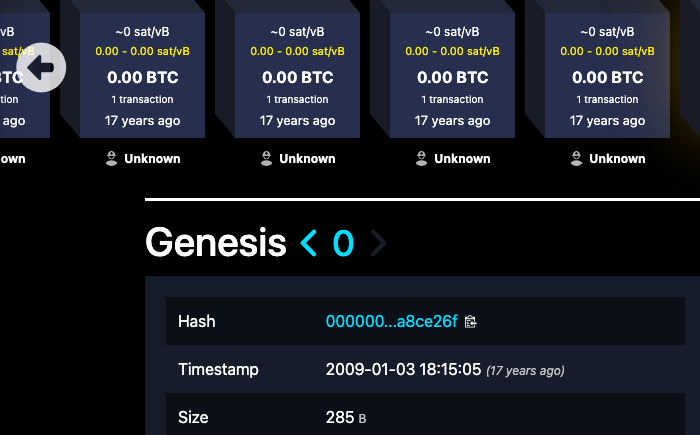
The Bitcoin genesis block on a public explorer, 3 January 2009.
The very first block Satoshi mined, on 3 January 2009. Those coins have sat at that address untouched for over fifteen years. Pull it up on any block explorer right now. Open the genesis block → See Satoshi's untouched coins on Arkham →

Sit with that. If you'd invented a scam to enrich yourself, this is the exact opposite of what you'd do. Scammers cash out. They pump and dump. They don't walk away from billions and never touch it.

The anonymous founder didn't vanish with the money. He vanished and left the money on the table. That's not the behaviour of a fraudster. It's closer to someone who deliberately stepped back so the thing he built couldn't be pinned on him, or run by him.

  1. 31 Oct 2008 Whitepaper published
  2. 3 Jan 2009 Genesis block, the network launches
  3. 12 Dec 2010 Last public forum post
  4. 23 Apr 2011 Last known email: “moved on to other things”
  5. 2010 → today ~1.1M BTC mined, zero coins ever moved
Satoshi's footprints stop in 2011. The coins he mined have never moved, the opposite of a founder cashing out. Verify the dormant coins on any block explorer. Whitepaper / forum archives / on-chain [1][2][3]

But even that's a side point. Here's the bit that genuinely settled it for me.

Satoshi has no special power over Bitcoin. None.

The code doesn't care who's around. The cap doesn't care.

This is what people miss when they picture a normal company. There's no head office, no CEO, no master switch.

Bitcoin's rules are enforced by software running on tens of thousands of independent computers all over the world. At the time of writing, the public tracker Bitnodes counts somewhere north of 20,000 reachable nodes, and the true number is higher because plenty run quietly behind firewalls 6.

Every one of those nodes checks every transaction and every block against the rules. The 21 million coin cap. The block reward schedule. All of it.

If Satoshi came back tomorrow and tried to change the code to mint himself more coins or lift the cap, he'd have to convince all of those independent operators to download and run his new version. They wouldn't.

They'd keep running the rules they already agreed to, and his version would be ignored as a separate, worthless fork. He has exactly the same power as you do if you download the software: the power to follow the rules, or to be quietly rejected by everyone who doesn't.

So the founder being gone changes nothing about how Bitcoin works. The code doesn't care who's around. The cap doesn't care.

"But what if he came back and sold all 1.1 million coins?" Fair question. The price would wobble, no doubt about it. But the supply cap wouldn't move, the rules wouldn't change, and the network would carry on producing blocks every ten minutes as if nothing happened.

Bitcoin has already swallowed a country banning it, exchanges collapsing with billions inside them, and an 80% crash, more than once. It absorbed all of it and the protocol never skipped a beat. One big seller is a price event, not an existential one.

Here's the reframe that flipped me from sceptic to owner. The anonymity isn't the weakness. It's a feature.

Think about what came before. DigiCash, founded by David Chaum in 1989, was brilliant cryptography, but it ran on a central server belonging to his company. When the company went bankrupt in 1998, the money died with it 7.

e-gold processed billions, then got shut down by the US government in 2007 7. Both had a known founder and a head office, which meant both had a single point of failure: a person to pressure, a door to kick in, a company to bankrupt.

Bitcoin has no figurehead to arrest, no CEO to lean on, no office to raid. You can't subpoena a ghost.

By disappearing and never touching his fortune, Satoshi removed the one thing every previous digital cash had and every government knew how to attack: a person in charge.

By disappearing and never touching his fortune, Satoshi removed the one thing every previous digital cash had and every government knew how to attack: a person in charge.

I came in thinking the missing founder was the red flag. I came out realising it might be the strongest thing about the whole design.

Don't trust me on it. The blockchain is public. Go and check those coins haven't moved yourself.

Sources (7)
  1. Bitcoin: A Peer-to-Peer Electronic Cash System (whitepaper, published 31 Oct 2008)
  2. Genesis block · Bitcoin Wiki
  3. Vanished but Not Forgotten: Revisiting Satoshi's Final Forum Post (final post 12 Dec 2010; last email to Mike Hearn 23 Apr 2011)
  4. Patoshi researcher Sergio Lerner on the ~1.1M BTC that will never move
  5. Onchain Data Locks In Satoshi's 1.1M BTC Hoard · Why It Never Moves
  6. Reachable Bitcoin Nodes · Bitnodes (live node count)
  7. Before Bitcoin: Early Digital Currencies and Why They Collapsed (DigiCash 1998 bankruptcy; e-gold 2007 shutdown)
09
Built by the CIA

Bitcoin Was Built By The CIA. The Conspiracy That Forgets To Read The Code

Short answer. You don’t build a control tool you can’t control. The code is open, and no agency can switch it off.

I used to half-believe this one. It has a nice ring to it. A currency this clever, born in 2008 from a faceless pseudonym, no founder to arrest, perfect timing right after a banking crisis.

Of course a three-letter agency cooked it up in a basement somewhere. It feels too neat to be an accident.

Bitcoin didn't drop out of a secret lab. Every piece was published in the open, with a name and a date, for 26 years before the whitepaper.
  1. 1982 Blind signatures / ecash, by David Chaum
  2. 1993 A Cypherpunk's Manifesto (“we publish our code”), Eric Hughes
  3. 1997 Hashcash (proof-of-work), by Adam Back
  4. 1998 b-money, by Wei Dai
  5. 1998-2005 Bit gold, by Nick Szabo
  6. 2004 RPOW (reusable proofs of work), by Hal Finney
  7. 31 Oct 2008 Bitcoin whitepaper, by Satoshi (cites hashcash + b-money)
Every building block of Bitcoin was published openly, in public, with an author's name on it. Primary papers, cypherpunk mailing-list archive

Then I actually looked into it, and the theory falls apart the moment you ask one question: where's the lever?

Because that's what an agency builds. A control tool has a backdoor, a kill switch, a master key, a quiet way to change the rules when it suits them. The whole point of a control instrument is that someone, somewhere, can reach in and pull a string.

So if Bitcoin is a CIA project, show me the string.

A backdoor you can read in plain sight isn't a backdoor. It's just text.

There isn't one. The code is open-source. Every line is public, has been since day one, and anyone on earth can read it, copy it, run it, or fork it 1.

There are thousands of independent nodes scattered across the planet, and no central party can quietly push a change that the rest won't notice and reject. Try to alter the 21 million supply cap and the network simply ignores you, the same way a chess engine ignores an illegal move.

A backdoor you can read in plain sight isn't a backdoor. It's just text.

Now the bit the conspiracy really trips over. The honest objection is "the NSA designed SHA-256, the hashing algorithm Bitcoin runs on." That's true, and I'm not going to wave it away.

SHA-256 is part of the SHA-2 family, which the NSA did design, and which NIST published as a US federal standard in 2001 2.

But "the NSA made it" and "the NSA controls it" are not the same sentence. SHA-256 was published openly, the steps are simple enough that a hidden trapdoor would be very hard to conceal, and by 2001 the agency had already worked out that slipping a backdoor into crypto destined for the whole civilian world was a daft idea 2.

It's also been picked apart by academic cryptographers for over two decades. It secures online banking, government systems, and the NSA's own classified traffic. If there were a secret flaw, the people best placed to find it are exactly the people hammering on it, and they'd have every incentive to shout.

But "the NSA made it" and "the NSA controls it" are not the same sentence.

Don't take my word for any of this. The algorithm is public. The analysis is public. Verify it yourself.

Here's the part the theory ignores entirely. Bitcoin didn't drop out of a secret lab. It was the obvious next step in a long, loud, openly published argument that ran for decades.

It starts with David Chaum, a Berkeley cryptographer who described blind signatures in 1982 and built the first real digital cash, ecash, through his company DigiCash from 1989 onwards 3.

Then came the cypherpunks, a mailing list of privacy-obsessed coders who, in March 1993, published Eric Hughes' manifesto with the line "Cypherpunks write code... Our code is free for all to use, worldwide" 4. That is the opposite of a secret agency. Their founding rule was publish everything.

From that list, the pieces of Bitcoin appeared one by one, in public, with dates attached. Adam Back proposed hashcash in 1997, the proof-of-work idea that makes spamming, or cheating a ledger, expensive 5. Wei Dai posted b-money in November 1998, a sketch of distributed digital cash 6.

Nick Szabo designed bit gold around the same time. Hal Finney built RPOW, reusable proofs of work, and released it in 2004 7.

By 2008, every ingredient was sitting on the table in plain view. When Satoshi Nakamoto posted the Bitcoin whitepaper to that same cypherpunk mailing list on 31 October 2008, the paper cited Back's hashcash and Dai's b-money directly 8.

Built in the open.
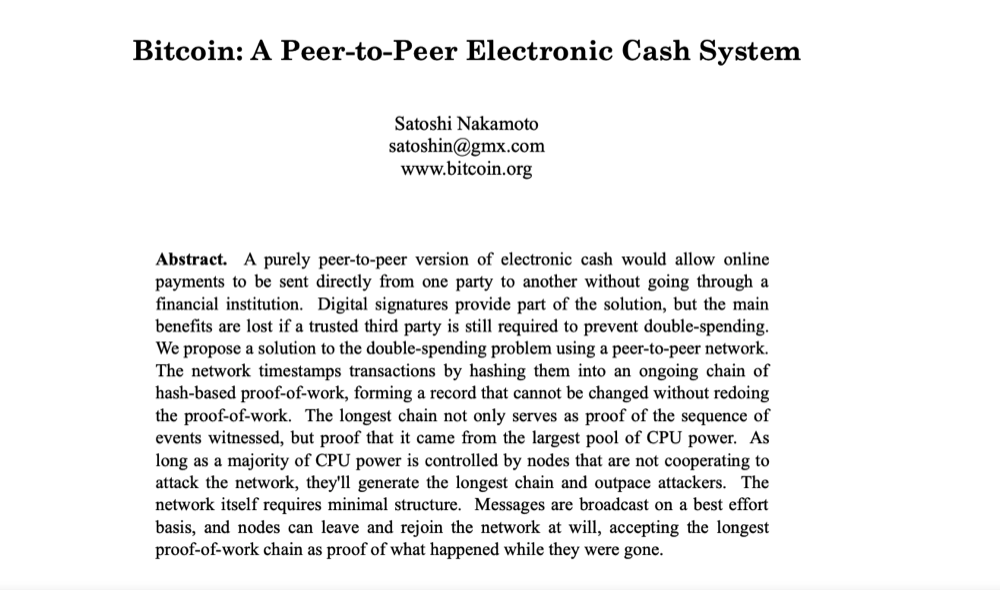
The Bitcoin whitepaper, Bitcoin: A Peer-to-Peer Electronic Cash System.
The Bitcoin whitepaper, posted to a public mailing list on 31 October 2008, citing the earlier public work it built on. A spy agency hides its work. This is the opposite of hidden. Read the whitepaper →

This wasn't a bolt from the blue. Two computer scientists, Arvind Narayanan and Jeremy Clark, later traced the whole lineage in an ACM journal piece bluntly titled "Bitcoin's Academic Pedigree," showing that nearly every component existed in the published research literature years before Satoshi assembled them 1. Their phrase for it is telling: the concept was "built from forgotten ideas in the research literature."

That's the killer detail. A spy agency hides its work.

That's the killer detail. A spy agency hides its work. The cypherpunks did the exact reverse for twenty-five years, arguing in the open on a public list, precisely because they didn't trust governments or banks with money or privacy.

Bitcoin is the thing those people built to get out from under exactly the kind of institution it's now accused of being.

So run the logic to the end. An agency builds tools it can switch off. Bitcoin is the one thing it can't switch off, can't fork against your will, can't inflate, can't quietly amend.

If the CIA built this, they built the single most effective device ever made for taking power away from agencies like the CIA. That's not a control tool. That's the escape hatch, and the blueprints have been public the whole time.

Sources (8)
  1. Bitcoin's Academic Pedigree · Narayanan & Clark, ACM Queue, Aug 2017
  2. SHA-2 (designed by NSA, published as NIST standard 2001; public scrutiny)
  3. Ecash / David Chaum (blind signatures 1982, DigiCash from 1989)
  4. A Cypherpunk's Manifesto · Eric Hughes, 9 March 1993
  5. Hashcash · A Denial of Service Counter-Measure · Adam Back (proposed 1997)
  6. B-money · Wei Dai, November 1998
  7. RPOW · Reusable Proofs of Work · Hal Finney, 2004
  8. Bitcoin: A Peer-to-Peer Electronic Cash System · Satoshi Nakamoto, 31 Oct 2008 (cites hashcash + b-money)
10
The whole space is scams

Crypto Is One Big Scam. Half Right, And That's The Point

Short answer. Plenty of crypto is a scam, and every one had a company and a CEO who could lie. Bitcoin has neither.

I used to say it too. Crypto is a scam, the whole thing, a casino dressed up as the future. And here's the bit that surprises people: I still think most of it is.

So let me concede this one harder than the believers usually like.

Every big crypto blow-up had the same missing part: a company and a person you had to trust. Bitcoin has neither.

A genuinely enormous amount of what gets called "crypto" has been theft. FTX collapsed in late 2022 with roughly $8 billion of customer money missing, money its founder Sam Bankman-Fried had quietly funnelled into his own trading firm 1. A jury convicted him on all seven counts, and a judge gave him 25 years and ordered $11 billion in forfeiture 1.

That same year, Terra and its "stablecoin" Luna evaporated in about three days, wiping out around $40 billion. In South Korea alone an estimated 280,000 people were caught in it 2. Do Kwon, the man behind it, was eventually sentenced to 15 years 2.

Then Celsius, the lender that told 1.7 million customers their money was safe and earning interest. Alex Mashinsky pleaded guilty to fraud, got 12 years, and forfeited $48.4 million; prosecutors said his conduct caused billions in losses 3.

That's three names. The wider picture is uglier.

Chainalysis, the blockchain analytics firm law enforcement actually uses, put illicit crypto transaction volume for 2024 at a lower-bound estimate of $51 billion 4. Scam addresses alone took in around $12 billion that year, and roughly 3.59% of every new token minted showed classic rug-pull behaviour 4.

So when somebody tells you the space is full of grifters, don't argue. Agree. Hand them better numbers than they had.

Now here's where I changed my mind.

Look at that list again, properly. Not at the size of the losses. At the shape of them.

FTX had a CEO. Celsius had a CEO. Terra had a founder. Every single one had a company, an office, a marketing budget, a man at the top who could promise you a yield, lie about where your money was, and move it while you slept. Every collapse is the same story wearing different branding: you gave your money to someone, and that someone betrayed you.

That is not a crypto problem. It's the oldest problem in finance. Bernie Madoff didn't need a blockchain.

The fraud wasn't the technology. The fraud was the trusted middleman, the single point of failure, the human you couldn't audit.

So I started asking a more useful question than "is crypto a scam." I started asking: which of these things actually has a person you'd need to trust?

And Bitcoin, the original, the one the casinos all got built next to, is the one answer where the honest reply is nobody.

Approx. value lostYearHad a company / CEO?
FTX~$8bn shortfall2022Yes, Sam Bankman-Fried (25 yrs)
Terra / Luna~$40bn wiped2022Yes, Do Kwon (15 yrs)
Celsiusbillions in losses2022Yes, Alex Mashinsky (12 yrs)
Rug pulls (2024)~$94.8m2024Yes, a founder every time
Bitcoinstill running2009-nowNo company. No CEO. No off-switch.
Every major crypto collapse had the same fatal ingredient: a company and a person you had to trust. Figures are approximate, rounded from the sources. Court filings / Chainalysis [1][2][3][4]

There's no Bitcoin company. There's no Bitcoin CEO to lie on a podcast. There's no headquarters for the FBI to raid, no founder to extradite, no quarterly results, no treasury someone can drain.

Satoshi Nakamoto wrote the software, gave it away, and vanished over a decade ago. If Satoshi turned out to be a fraud tomorrow, the network wouldn't so much as hiccup, because there's nothing for one person to switch off.

Tens of thousands of independent computers run the same rules, and you can download those rules and check them yourself. The supply cap is 21 million. You don't take my word for that. You verify it.

That is the entire difference, and it took me embarrassingly long to see it.

What people call "crypto" is mostly companies. Exchanges, lenders, yield platforms, token foundations, all centralised businesses run by people who can fail or lie or both.

FTX was a company. Celsius was a company. Terra was a company. They printed tokens, called them currencies, and ran old-fashioned frauds with a new coat of paint. Bitcoin isn't a company. It's a protocol. A set of rules running on a network nobody owns.

So judging Bitcoin by FTX is like judging email because someone emailed you a scam. The scam used the rails. The scam wasn't the rails.

So judging Bitcoin by FTX is like judging email because someone emailed you a scam.

I'm not telling you the price won't swing or that there's no risk left, because there is. What I am telling you is that the specific risk that wiped out everyone on that list, a trusted insider stealing the lot, is the exact risk Bitcoin was built to remove.

That was the whole point. No company to go bust. No CEO to cuff. No single throat to choke, which also means no single hand to rob you.

When the next blow-up lands, and one will, watch for the pattern. There'll be a founder. There'll be a logo. There'll be customer funds that turned out not to be where they said. And it'll get filed under "crypto," and people who never looked closely will nod and say, see, told you.

Notice what it had. A company. A boss. A promise.

Then notice the one thing on the whole list that has none of those, and is still running this morning exactly as it ran the morning FTX died.

Sources (4)
  1. Sam Bankman-Fried sentenced to 25 years in prison for orchestrating FTX fraud
  2. Terraform Labs founder Do Kwon sentenced to 15 years over $40 billion Terra-Luna collapse
  3. Founder of Celsius Sentenced To 12 Years For Fraud And Market Manipulation
  4. 2024 Crypto Crime Trends · Chainalysis
11
It just makes a new elite

It Just Creates A New Elite. Except This Time The Insiders Can't Rig It

Short answer. The early holders got rich, but they can’t pull the ladder up: no printing more, no bailouts, no changing the rules.

"Fine. Maybe it's not a scam. But it just hands all the wealth to a new set of insiders. Same game, new winners."

Being early isn't a scam. It's being early.

The early holders got rich, yes. The difference is they can't pull the ladder up: they can't print more, can't bail themselves out, can't change the rules. The fiat insiders next to the printer can do all three.

The people who bought Bitcoin years ago and held got rich, and pretending otherwise is silly. So let me give you the actual difference, because it's the whole point.

They can't pull the ladder up behind them.

An early holder can't print themselves more, because the supply is fixed at 21 million and the nodes enforce it. They can't bail themselves out when they're wrong.

They can't change the rules in their favour, because nobody can, not the biggest whale, not the developers, not a government. Their only edge was showing up early and taking the risk when it was unpopular. Once you're in, you play by the exact same rules they do.

Now hold that against the system we already live in. When new money is printed, it doesn't reach everyone at once. It goes to the banks and the people closest to the tap first, at full value.

They buy assets before prices rise. By the time it reaches your wages, prices have already moved and your share buys less.

Economists have a name for it, the Cantillon effect, and it's a permanent, built-in advantage for the insiders nearest the printer 2. That's a rigged game. Bitcoin has no printer, and no first-in-line.

Fiat insiders (nearest the printer)
  • Get freshly printed money first, at full value
  • The Cantillon effect, built into the system
  • Can be bailed out when they're wrong
  • Can change the rules in their favour
  • You get the same money later, worth less
Bitcoin's early holders
  • Got in early, that was the whole edge
  • Can't print themselves more (21M, fixed)
  • Can't bail themselves out
  • Can't change the rules, nobody can
  • Can't stop you joining, buy £5 from your phone
Every money has insiders. The only question is whether they can rig it after you arrive. Fiat's can. Bitcoin's can't. Glassnode / Mises / Dan Held [1][2][3]

And the early stash doesn't stay bunched at the top. Year after year, coins move from the original holders out to new ones, and the spread has widened as Bitcoin has grown 1.

Most of the scary-looking "whale" wallets aren't one tycoon either; they're exchanges and funds holding coins for millions of ordinary people 1.

Here's the bit that matters. Bitcoin is the one system where the insiders can't stop anyone else joining.

No gatekeeper, no minimum, no "accredited investor" rule. You can buy five pounds of it from your phone tonight, on the exact same terms as BlackRock 3. Try that with the early shares in any company you've heard of.

Don't take my word for it. The supply sits on a public chain anyone can analyse. Go and look at how it's spreading.

Sources (3)
  1. Bitcoin Supply Distribution Revisited (how coins have spread from early holders; large balances held by exchanges/funds) · Glassnode Research
  2. Cantillon Effects: Why Inflation Helps Some and Hurts Others · Mises Institute
  3. Bitcoin's Distribution Was Fair · Dan Held
12
Quantum will crack it

Quantum Computers Will Crack It. They'd Crack Your Bank, Your Email And Every Government Secret First

Short answer. A real but distant risk to the signature, not the network. Modern wallets are safe, only old exposed-key coins are, and it’s fixable by upgrade.

"Right, I've got you now. Quantum computers will break the encryption and steal everyone's Bitcoin."

This is the one objection on the list I won't wave away, because the maths is real.

A quantum computer can't break Bitcoin's hashing or its rules. It threatens one thing, the signature, and only once your public key is exposed. Modern wallets keep it hidden; the only real target is old coins that never moved.

So let's open it up properly, because once you see how Bitcoin's cryptography actually works, the threat gets far more specific, and far smaller, than "they take everything."

Bitcoin leans on two different bits of maths, and they are not equally exposed.

The first is SHA-256. It's a hashing function. It runs the mining, and it turns your public key into the short address you hand out.

Quantum barely touches it. The best known quantum attack on a hash, Grover's algorithm, only cuts its strength in half, from absurd to still absurd, so SHA-256 holds up fine.

The second is ECDSA. This is the digital signature that proves you own your coins and lets you spend them.

This is the part a large quantum computer could, in theory, break, using Shor's algorithm to work backwards from a public key to the private key 1. Frightening, until you notice the catch: it can only do that once your public key is visible on the chain.

SHA-256 (the hashing)
  • Runs mining, and turns your public key into your address
  • Quantum only halves its strength (Grover), so it stays unbreakable
  • Your address is a hash, so it hides your public key
ECDSA (the signature)
  • Proves you own your coins and lets you spend them
  • A large quantum computer could crack this (Shor's algorithm)
  • But only after your public key is exposed on the chain
Bitcoin runs on two kinds of maths. Quantum barely dents the hashing. It only threatens the signature, and only once your public key is on show. Bitcoin Wiki [1]

And that is the part that matters for you personally. If you hold your own Bitcoin in any modern wallet, you are almost certainly fine.

Modern wallets hand out a fresh address every time and never reuse one. Your coins sit at an address that is only a hash of your public key, so there is no public key on the chain to attack.

It appears for a moment when you spend, and by then the rest has already moved to a new, hidden address.

So who is actually exposed? Old coins that have never moved.

The earliest Bitcoin was paid straight to public keys, fully visible, including roughly 1.1 million coins mined by Satoshi and untouched since. Add the addresses reused so heavily that their public key is already public, and analysts put the genuinely vulnerable pile somewhere between 1.5 and 4 million BTC 2. That is what a quantum attacker would go for, not your stack.

Your coins (a modern wallet)
  • A fresh address every time, never reused
  • Your public key stays hidden behind the hash
  • Exposed only for a moment when you spend, then moved on
  • You can shift to a quantum-proof address in the upgrade
The real target (old, dormant coins)
  • ~1.5 to 4 million BTC unmoved for years
  • Early 'pay to public key' coins, including Satoshi's ~1.1M
  • Addresses reused until the public key is already public
  • Even if taken and sold, the rules and 21M cap don't change, only the price
If a quantum computer ever arrives, it goes after exposed public keys: old, never-moved coins, not the Bitcoin in your modern wallet. Deloitte [2]

And even in that worst case, sit with what would actually happen. Those specific old coins could be moved and sold. That's it.

The rules don't change. The 21 million cap doesn't change. The network keeps producing a block every ten minutes.

Nothing about how Bitcoin works breaks. The only thing that moves is the price, and only while the market digests it.

Because, finally, Bitcoin can change its own locks. It's a protocol, and protocols upgrade.

The wider world is already moving: in 2024 the US standards body, NIST, published the first finished post-quantum encryption standards 3. Bitcoin developers are already drafting the matching upgrade, so people can shift their coins to quantum-proof addresses long before any of this is real 4.

And remember, the same machine that could pull this off breaks your bank, your email and every government secret first, so the warning will be deafening.

So: a genuine risk, in the signature scheme, aimed almost entirely at old dormant coins, that leaves the protocol itself untouched and is fixable by an upgrade already being written. "Real, narrow and fixable" is a long way from "quantum kills Bitcoin."

Don't take my word for it. The cryptography is public, the vulnerable-coin analyses are public, and the upgrade proposals are argued over in the open. Go and read them.

Sources (4)
  1. Quantum computing and Bitcoin (ECDSA is the exposed part via Shor's algorithm; SHA-256 only weakened by Grover; hashed addresses keep your public key hidden) · Bitcoin Wiki
  2. Quantum Computers and the Bitcoin Blockchain (estimate of coins sitting in exposed or reused addresses) · Deloitte
  3. NIST releases first finished post-quantum encryption standards (2024) · NIST Post-Quantum Cryptography
  4. BIP-360: Pay to Quantum Resistant Hash, a proposed Bitcoin upgrade path
13
Governments will ban it

They'll Just Ban It: The Objection That Keeps Losing

Short answer. You can’t ban maths running on every continent. The states that tried hardest now mine it or hold it in reserve.

I used to think this was the killer argument. Bitcoin only works while governments tolerate it, and the second it gets big enough to matter, they'll outlaw it and that'll be that.

It felt obvious. It's the kind of thing you can say at a dinner party and watch everyone nod.

Every 'ban' has the same plot. The network routes around it, and the country that tried hardest now mines more Bitcoin than almost anyone.
Country / bodyThe actionWhat actually happened
ChinaFull crypto + mining ban, Sept 2021Mining fell to ~0%, then rebounded to ~12% of global hashrate, 3rd worldwide
NigeriaBanned banks from servicing crypto, Feb 2021Trading went peer-to-peer, among the world's highest volumes. Its own eNaira CBDC flopped (~98.5% of wallets unused)
IndiaYears of ban threatsSettled on a 30% tax + 1% TDS in 2022, not a ban
United StatesExpected crackdownApproved 11 spot Bitcoin ETFs Jan 2024; created a Strategic Bitcoin Reserve, March 2025
What actually happened when governments 'banned' Bitcoin, and the reversal in the US. All figures verifiable via the sources. Cambridge / Chainalysis / EO 14233 [1-8]

Then I did the boring thing and looked at what actually happened in the countries that tried.

Start with the concession, because it's a fair one. Governments are powerful. They can jail people, freeze bank accounts, block exchanges and make life genuinely miserable for anyone caught holding.

Nobody serious denies that. The question isn't whether a state can make Bitcoin illegal. It's whether doing so actually makes Bitcoin go away.

That's a different question, and the track record answers it.

Take China. Not a country known for losing fights with its own population.

Beijing has "banned" Bitcoin more than once: trading restrictions in 2013, an ICO and exchange crackdown in 2017, then a full sweep in 2021 when the People's Bank declared all crypto transactions illegal and outlawed mining outright 1. China had been producing around 65% of the world's mining power. By the summer of 2021 Cambridge's data showed its share crater to roughly zero 2.

Case closed, you'd think. Except the miners didn't vanish.

They went quiet, moved underground in Sichuan and Xinjiang where power is cheap, and China clawed its way back to around 12% of global hashrate, third behind the US 2. The most surveilled country on earth banned a thing and the thing kept running inside its own borders.

Nigeria is the cleaner experiment. In February 2021 the Central Bank told commercial banks to stop servicing crypto firms 3.

The state response to "people are using Bitcoin" was to cut the on-ramp. Trading didn't stop, it just moved person-to-person. Nigeria went on to record some of the highest peer-to-peer volumes anywhere on the Chainalysis adoption index 3.

Meanwhile the government's own answer, a central bank digital currency called the eNaira, flopped so badly that the IMF found something like 98.5% of wallets had never been used in a given week 4. People didn't want the state coin. They wanted the one the state was trying to ban.

Lagos eventually gave up on the bank restriction and moved towards regulating instead.

India is the same arc in slow motion. Years of ban threats and RBI hostility, and what did they land on in the 2022 budget? Not a ban. A 30% tax on gains plus a 1% deduction at source on every trade 5.

That tax hurt; Indian exchange volumes fell sharply and traders shifted offshore 5. But notice the move. The threatened ban became a revenue stream.

You don't write a tax code for something you intend to abolish. Taxing it is the state quietly admitting it's here to stay.

That's the pattern across all three. You can't ban maths that runs on every continent at once. Bitcoin isn't a company with an office to raid; it's a protocol running on tens of thousands of independent computers across every jurisdiction.

Outlawing it at home is a lot like the early panic about banning the internet. You don't kill the network. You push your own citizens onto worse tools and watch the activity go grey-market while it carries on everywhere else.

The ban mostly hurts the country that issues it.

Here's the part that should bother any honest sceptic, because it's the bit I couldn't argue around.

If Bitcoin is destined for the dustbin, somebody forgot to tell the world's most powerful governments and asset managers. In January 2024 the US SEC approved eleven spot Bitcoin ETFs 6.

These aren't fringe outfits; BlackRock's fund alone grew into one of the fastest-growing ETFs in history, with the spot-Bitcoin complex pulling in tens of billions and BlackRock's IBIT becoming a top revenue product for the firm 7. The same regulatory apparatus people assumed would outlaw Bitcoin instead handed Wall Street a wrapper to sell it to pension funds.

Then, in March 2025, the US went further and established a Strategic Bitcoin Reserve by executive order 8. The government formally decided to hold its Bitcoin (largely coins seized in criminal cases, with the US sitting on well over 100,000 BTC) as a strategic asset rather than auction it off, and directed the Treasury to find budget-neutral ways to acquire more 8.

Read that order's own language and it calls Bitcoin scarce and secure and notes the "strategic advantage to being among the first nations" to stockpile it 8.

You do not build a reserve of something you're about to outlaw.

You don't stockpile what you plan to ban.
A chart of nation-states holding Bitcoin, growing year on year.
More and more governments now hold Bitcoin on their own books. The states that tried hardest to ban it are quietly accumulating it. See who holds it →

And that's the game-theory trap that closes the door on the ban argument for good. The moment one major state treats Bitcoin as a reserve asset, every rival has to ask whether they can afford not to.

Banning it no longer just inconveniences your own citizens; it cedes ground to the country that didn't. The incentive flips from "stamp it out" to "get some before the others do."

You do not build a reserve of something you're about to outlaw.

That's not a prediction about price. It's what nations do with scarce, neutral, hard-to-seize assets once a competitor starts accumulating.

So the honest version of the objection isn't "they'll ban it." It's "they'll try to control it, tax it, and quietly accumulate it." A very different sentence, and a much less reassuring one if your whole thesis was that Bitcoin goes to zero by government decree.

Don't take my word for any of this. The executive order is on the Federal Register, the SEC approval is on sec.gov, and Chainalysis publishes the adoption data. Go and check the ones that surprise you.

Sources (8)
  1. China declares all cryptocurrency transactions illegal (Sept 2021) · BBC News
  2. Assessing China's crypto ban three years later (mining rebounded to ~3rd worldwide) · Bitcoin Policy Institute
  3. Why Nigeria rolled back crypto restrictions / P2P growth after the 2021 bank ban
  4. Nigeria's eNaira, One Year After (~98.5% of wallets unused) · IMF Working Paper
  5. India's 30% crypto tax and 1% TDS (2022 Union Budget) · ClearTax
  6. SEC approves spot Bitcoin ETFs, Jan 2024 (Gensler statement)
  7. Bitcoin ETFs become a top BlackRock revenue source / IBIT growth
  8. Executive Order 14233, Establishment of the Strategic Bitcoin Reserve, Federal Register, 11 March 2025 (90 FR 11789)
14
It can’t scale

It's Too Slow to Be Money. And Why Your Bank Already Works in Layers Anyway

Short answer. The base layer settles, like Fedwire. Lightning does the coffee, instantly and for a fraction of a penny.

I used to think this was the knockout blow. Bitcoin does about seven transactions a second 1, and a new block lands roughly every ten minutes 2. Visa says it can handle more than 24,000 a second at peak 3.

Game over, surely. A currency that makes you wait ten minutes and caps out at the speed of a parish noticeboard is never buying anyone a coffee.

Money has always worked in layers. Bitcoin just makes its base layer one you're allowed to hold and to check.

Then someone asked me a question I couldn't answer. How do you think your debit card works?

Here's what I'd missed. Bitcoin's base layer is slow on purpose. The ten-minute block and the tiny throughput aren't bugs the developers forgot to fix.

They're the price of having tens of thousands of independent computers all over the world agree on the same ledger, with no boss, no off switch, and no one who can quietly edit the numbers. Speed and global, leaderless, tamper-resistant settlement pull in opposite directions. Bitcoin chose settlement.

SystemSpeed you feelSettlement underneathTypical feeHold the base layer?
Visa / debit card1-2 sec1-3 days, via Fedwiremerchant ~1-3%No, the bank holds it
Fedwire (USD base)Same-day, business hoursFinal, central-bank moneyhigh, large-value onlyNo, banks only
Bitcoin base layer~10 min blockFinal, ~10 minvariable network feeYes, your keys
Bitcoin + LightningInstantsettles to base chainunder 1 cent on small paymentsYes, leave any time
Money has always worked in layers. Bitcoin just makes its base layer one you're allowed to look at. Visa / Fed / Lightning data [1-7]

Lyn Alden, who writes some of the clearest material on this, puts it well. "A tank is ideal if you need to get from point A to point B through hostile terrain, and blast through anything in your path. It's not ideal for commuting to work in." 4

You don't drive a tank to the shops. You also don't settle a house purchase with a suitcase of cash, and you don't fire off a Fedwire to buy a sandwich. Different jobs, different tools.

Which brings us to the bit that demolished my objection. Every working money is layered. Always has been.

When you tap your card, no central-bank money moves. Visa authorises the payment in a second or two, but the real settlement between the banks happens later, in batches, often a day or three afterwards 35.

Underneath the cards sits a slow, heavily guarded settlement layer. In the US that's Fedwire, the Federal Reserve's wire system. It's not fast and it's not cheap, and nobody minds, because it isn't meant for sandwiches.

In 2024 Fedwire moved about $4.5 trillion a day, across roughly 210 million transfers for the year, at an average of $5.4 million per transfer 6. That's the base layer of the dollar. Slow, high-value, final.

The fast, cheap stuff you actually touch sits on top.

So when a sceptic says Bitcoin is too slow to be money, what they've spotted is that Bitcoin has a settlement layer. So does the dollar.

The difference is that Bitcoin's is open for anyone to verify, and the dollar's runs through a handful of institutions you're not allowed to see inside.

Now the second half of the objection, the cleverer one. "Fine, but Lightning just brings the middlemen back. You've reinvented the bank."

Lightning is Bitcoin's payment layer. Two people open a channel anchored to the base chain, fire payments back and forth instantly, and only settle to the main chain when they're done.

The numbers are genuinely good. In River's study of its own traffic, the typical Lightning payment was around $11.84, payments succeeded 99.7% of the time across more than 308,000 of them, and fees on a small payment routinely come in under a single cent 7.

Instant, sub-penny, and final enough for a coffee. That's the coffee problem solved, on a different layer, exactly as Alden says every successful financial system does it. "Every successful financial system uses a layered approach, with each layer being optimal for a certain purpose." 4

Instant, sub-penny, and final enough for a coffee.

But does it bring the middlemen back? Look rather than assume.

You have two ways to use Lightning. Run your own node and open your own channels, which is fully non-custodial: nobody holds your coins, nobody can freeze you, nobody is in the middle. It takes some learning, the way running your own anything does.

Or download an app, and here you get a choice Alden spells out: self-custodial apps like Muun or Breez, where "you have full control over your own coins, and are just using their open source software," or custodial ones like Cash App, where "you are trusting a company with your money." 4

So yes, pick a custodial app and you've accepted a middleman. A small, optional, you-chose-it middleman, for the convenience of not managing channels.

And the crucial part, the part that doesn't exist in banking: you can leave any time. Move your Bitcoin back down to the base layer, to your own keys, and the middleman is gone.

Try that with your bank. Try holding base-layer central-bank money directly. You can't.

You're a permanent custodial customer of a commercial bank whether you like it or not, and they can freeze the account on a Tuesday.

That's the reframe that did it for me. The objection assumes layers mean surrender. But in the legacy system the middleman is mandatory and the base layer is off-limits to you.

With Bitcoin the middleman is optional and the base layer is yours whenever you want it. That's not "the middlemen are back." That's strictly more freedom than you have now, with a dial you control between convenience and sovereignty.

Don't take my word for any of it. Run a Lightning payment yourself with a non-custodial app and watch it clear before you've put the phone down. Then ask your bank to show you Fedwire. One of those two you're allowed to inspect.

Sources (7)
  1. Bitcoin Transaction Speed (layered scaling overview, ~7 tps)
  2. Bitcoin Scalability: ~10-minute blocks, ~1MB, throughput bottleneck
  3. How Many Transactions Does Visa Process Per Second? (24,000 tps peak claim vs ~1,700 average)
  4. Lyn Alden, "A Look at the Lightning Network" (tank quote, layered-system quote, custodial vs self-custodial)
  5. The Payment Stack: authorisation now, settlement 1-3 days later via ACH/Fedwire
  6. Fedwire Funds Service 2024 figures (~$4.5T/day Q2 2024, ~210M transfers, $5.4M avg)
  7. River Lightning Report 2023 (typical payment ~$11.84, 99.7% success over 308,000 payments, sub-cent fees)
15
Nobody uses it

Nobody Actually Uses Bitcoin. Then Who Are The 365 Million?

Short answer. Whole towns run on it, and "nobody uses it" is exactly what they said about email in 1994.

I used to say this one with real confidence. Nobody pays for anything with Bitcoin.

I'd never seen a price tag in Bitcoin, never watched anyone tap a phone for a coffee with it, so case closed. It sounds airtight right up until you check it.

From 35 million owners to 365 million in seven years. That's the early bend of an S-curve, not a plateau.

Let me concede the true bit first, because most of it is.

If you mean "can I buy a flat white down my road with Bitcoin," then yes, for most people in Britain, nobody does. That's real. And here's the part the slogan misses: a lot of that is on purpose.

If you genuinely think Bitcoin is money that gets scarcer over time while the pound gets printed, you don't spend the Bitcoin. You spend the weak money and hold the hard money.

Economists have a name for this going back to the 1500s, Gresham's law: bad money drives out good. People hoard the thing they expect to appreciate.

Low spending in a rich, stable-currency country isn't a sign the thing is dead. It's a sign people are using it as savings, exactly what you'd predict.

But "nobody" is just wrong, and the numbers aren't close.

Triple-A, a payments firm, puts global cryptocurrency ownership at over 560 million people, around 6.8% of the planet 1. Their later breakout has Bitcoin owners specifically rising from 337 million in 2024 to 365 million in 2025, nearly half of all crypto holders 2. Crypto.com's tracker, using a different method, lands in the same neighbourhood, 741 million total owners by 2025 3.

Pick the conservative figure and you've still got more people holding Bitcoin than live in the United States. "Nobody" is doing a lot of heavy lifting there.

Global Bitcoin owners (millions) 35m 2018 100m 2021 337m 2024 365m 2025
Estimated global Bitcoin owners, 2018-2025. The shape is the early bend of an S-curve, not a plateau. Triple-A / Crypto.com estimates

Owning isn't spending, fair enough. So look at merchants.

I went and tried it myself.
Not a thought experiment. That's me and my friend TC taking Bitcoin into a local farmers shop, talking them through it and asking them to take it for real food. Some did.

BTC Map, an open community directory, listed roughly 19,900 businesses heading into 2026, with verified-in-the-last-year merchants up 53% across 2025, growth that Casa's Jameson Lopp credited largely to Block's Square rolling out Bitcoin acceptance at the till 4.

It's not Visa, and nobody's claiming it is. But twenty thousand shops is not zero shops.

See it for yourself.
BTC Map showing shops and cafes accepting Bitcoin across Europe.
Every pin is a shop or cafe taking Bitcoin. Open the BTC Map app and there's a good chance somewhere near you already does. Find one near you →
Whole towns already run on it.
BTC Map of Bitcoin Ekasi in Mossel Bay, South Africa: dozens of local shops accepting Bitcoin.
Bitcoin Ekasi, Mossel Bay, South Africa. Not a pilot. A township where the shops, the barber, the car wash and the preschool all take Bitcoin, day in, day out. Explore it on BTC Map →
And a whole town in El Salvador.
BTC Map of Berlin, El Salvador: nearly a hundred local businesses accepting Bitcoin.
Berlin, El Salvador. Pizzerias, pharmacies, hardware shops, hair salons. Almost a hundred local businesses taking Bitcoin in one small town. Explore it on BTC Map →

The bit that actually changed my mind was the circular economies. Whole towns where Bitcoin loops: you earn it, you spend it, the shop pays its supplier in it, and it never has to touch a bank.

El Zonte in El Salvador, nicknamed Bitcoin Beach, is the original. Since 2019, locals there pay for utility bills, medical care, food and haircuts over the Lightning Network, Bitcoin's fast, cheap payments layer 5.

Worth being precise here, because the sceptic's version of this is usually out of date: El Salvador made Bitcoin legal tender in 2021, then walked it back in early 2025 under IMF pressure as a condition of a $1.4 billion loan 6.

So Bitcoin is no longer legal tender there. The national top-down experiment got reined in. But the bottom-up village economy that started it all carries on, and that was always the interesting bit.

It's not a one-off either. Lugano, a city in Switzerland, runs "Plan ₿" with over 350 merchants taking Lightning payments through a city app 7.

Madeira, the Portuguese island, passed 100 Bitcoin-accepting businesses 8. Costa Rica's "Bitcoin Jungle" grew to around 400 businesses by 2024 9.

Different countries, same pattern, repeated by people with no reason to coordinate.

And then there's the answer to "but why would you ever use this." Go where the local money is broken.

This is what quietly demolished my objection. Chainalysis runs a Global Crypto Adoption Index that weights for grassroots, real-person use rather than big trading desks.

The top of that index isn't America or Britain. It's India, Nigeria, Indonesia, Vietnam, the Philippines, with Nigeria receiving roughly $59 billion in crypto value in a single year 10. These are places with double-digit inflation, currency controls, and family members working abroad.

When your own currency loses a third of its value, "nobody uses Bitcoin" stops being an argument and starts being a luxury opinion you can only hold from inside a stable economy.

Remittances are the clearest case. Sending money home through Western Union can cost 6 to 10% and take days. Over Lightning it's seconds for a fraction of a cent.

El Salvador's Chivo wallet alone processed 4.2 million Lightning transactions in 2025, mostly remittances and shop purchases 11.

The total is still a small slice of the country's remittance flow, I won't pretend otherwise. But it works, it's live, and it's growing from a base of zero a few years ago.

Which brings me to the analogy I keep coming back to. In 1994, if you'd said email would replace the post, a sensible person would've laughed. Almost nobody had it.

The interfaces were ugly, you needed a nerd to set it up, and your nan certainly wasn't sending you anything. "Nobody uses email" was technically true and useless as a prediction.

That's what low usage looks like at the start of an S-curve, not at a dead end. The honest version of the objection isn't "nobody uses Bitcoin." It's "not many people near me use it for payments yet, partly because they're saving it and partly because the pound still works." Both true. Neither means what the slogan wants it to mean.

Don't take my word for it. The whole point of Bitcoin is verify, don't trust. Go look at the map. Count the shops yourself.

Sources (11)
  1. Cryptocurrency Ownership Data, Triple-A
  2. The State of Global Cryptocurrency Ownership (Bitcoin owners 337m→365m), Triple-A
  3. The State of Global Cryptocurrency Ownership, Triple-A
  4. Bitcoin Merchant Adoption Surges 53% In 2025 (BTC Map data), Benzinga
  5. Bitcoin Beach / El Zonte circular economy
  6. Bitcoin is no longer legal tender in El Salvador (IMF $1.4bn loan condition), Digital Watch Observatory
  7. Lugano's Plan ₿
  8. Madeira Tops 100 Businesses Now Accepting Bitcoin, Velas Commerce
  9. Inside Costa Rica's Growing Bitcoin Circular Economy (Bitcoin Jungle), Bitcoin Magazine
  10. 2024 Global Crypto Adoption Index, Chainalysis
  11. Deep Dive Into Breez' 2025 Lightning Network Report (Chivo 4.2m Lightning txns), Blink
16
Too volatile

It's Too Volatile To Be a Store of Value

Short answer. Still volatile, but steadier every cycle and the floor keeps rising. It’s being monetised, the way gold once was.

I used to roll my eyes at this one from the other side. Someone would call Bitcoin a store of value while it was down 60% on the month, and I'd think: mate, a store of value is the thing that doesn't do that.

You can't hold up a fire extinguisher that's also on fire.

Same $60k price, nearly half the wobble. In 2021 Bitcoin's volatility ran around 80%. By 2024 it was in the mid-40s, and still falling.

Let me concede the obvious first, because the objection has real teeth. Bitcoin is brutally volatile in the short term. It has had multiple drawdowns of 70% or more.

As I write this in June 2026 it's trading around $64,000, roughly half of its October 2025 peak near $126,000 1.

Nobody sane wants their rent money in something that can lose a third of its value in a bad quarter. If your time horizon is next year's holiday fund, Bitcoin is a terrible place to park it, and anyone telling you otherwise is selling something.

So we've agreed it's not a stable place to keep money you need soon. Now look at the part the objection quietly skips.

Volatility has trended down for fifteen years

This isn't a vibe, it's measurable. Fidelity Digital Assets, not exactly a meme account, tracks Bitcoin's realised volatility over its whole life.

In the early years annualised volatility "regularly hit triple digits, even breaching 200%." By April 2024 the 90-day figure was around 46%, and Fidelity notes that realised volatility under 50% has only happened in about 5% of Bitcoin's existence 2.

By early 2026 one-year realised volatility was setting fresh all-time lows, and Bitcoin had become less volatile than dozens of individual S&P 500 companies 3.

Here's the cleaner way to see it. At $60,000 in 2021, Bitcoin was nearly twice as volatile as it was at the same $60,000 in 2024 2. Same price, half the wobble. Bitcoin is getting steadier as it gets bigger. That's not a coincidence, it's the whole point.

Annualised realised volatility (%) ~150% 2012 ~95% 2015 ~85% 2018 ~80% 2021 ~46% 2024 ~42% 2026

By early 2026 Bitcoin's one-year realised volatility was lower than dozens of individual S&P 500 stocks.

Bitcoin's annualised realised volatility has fallen from triple digits in its early years to the mid-40s. It is still volatile, just less so each cycle. Realised-vol data, multiple providers

This is what monetisation looks like

The framing that finally moved me was Vijay Boyapati's. In "The Bullish Case for Bitcoin" he argues money doesn't arrive fully formed. It crawls through stages: collectible first, then store of value, then medium of exchange, then unit of account.

Crucially, the store-of-value role comes before everything else, and an asset being actively monetised is volatile by nature, because the market is arguing in real time about what it's finally worth 4.

Volatility, in other words, is the price of admission for something still being repriced upward. It cuts both ways. The same machinery that produces those gut-churning 70% drops also produces the recoveries that follow. You don't get one without the other while an asset is still finding its level.

Gold did this too. We treat gold as the boring, grandfatherly store of value, but after it was unpegged from the dollar in the 1970s it went through its own violent price-discovery decade before settling into the calm asset we picture today.

Fidelity draws exactly that parallel: gold's volatility declined as it matured, and Bitcoin appears to be walking the same path 2. Nobody now says gold "can't be a store of value because look at 1980."

The honest bit, including where the easy answer breaks

I want to be careful here, because this is where Bitcoiners often overreach. For years the comforting line was that no four-year holding period ever ended in the red, propped up by the 200-week moving average that had caught every cycle bottom.

That line needs an asterisk now. Bitcoin dipped below its 200-week average during the 2022 bear before reclaiming it 5, and 2025 was the first post-halving year in Bitcoin's history to close down, roughly 30% off its high 6.

The neat four-year cycle some people treated as a law of physics has, at minimum, changed shape.

So I won't sell you a guarantee that doesn't exist. What survives the asterisk is what actually matters: the long-horizon, view-it-over-years record is still strongly positive, and the volatility trend is still pointing down as the network deepens and the buyer base shifts toward institutions who don't panic-sell at 3am 6.

The 200-week average sits above $60,000 as of mid-2026 and keeps grinding higher, cycle after cycle 7. The floor rises. That's the signal underneath the noise.

The floor rises. That's the signal underneath the noise.
Stop watching the daily price.
Bitcoin's 4-year (200-week) moving average price: a smooth line rising every cycle from near zero to above $60,000.
The daily price is the noise. This is Bitcoin's 4-year (200-week) average price, the floor underneath it. It has risen every single cycle and never once broken. Watch this line instead of the daily candles and a store of value is exactly what you see. (Coinglass, 4-year moving average.)

So is Bitcoin a stable, day-to-day store of value right now? No. I won't pretend otherwise, and you should distrust anyone who does. It's still being monetised, and monetisation is messy.

But "too volatile, full stop" mistakes a snapshot for the trend. The volatility is shrinking, the time horizon that matters is measured in years not weeks, and the comparison asset, gold, did exactly this before we crowned it.

Don't take my word for any of it. The numbers above are all public. Go pull the volatility chart yourself.

(This is the written companion to our store-of-value video, which goes deeper on the 70% drops specifically.)

Sources (7)
  1. Bitcoin drops back under $70,000, Strategy extends its slide (CNBC, June 2026)
  2. A Closer Look at Bitcoin's Volatility (Fidelity Digital Assets)
  3. Bitcoin's Volatility Is Falling and This Will Continue as It Matures: Fidelity (CoinDesk)
  4. The Bullish Case for Bitcoin · Vijay Boyapati
  5. Bitcoin 200-Week Moving Average Heatmap (a key historical support level) · LookIntoBitcoin
  6. Is Bitcoin's Four-Year Cycle Over? (Fidelity Digital Assets)
  7. Bitcoin's 200-Week Moving Average Hits $60,517, Price Surpasses $80,000 (KuCoin)
17
What if the internet goes down?

Bitcoin Dies If The Internet Dies? Look What Dies First.

Short answer. Satellite, radio and even SMS keep it alive, and your seed phrase survives an EMP. Only an apocalypse that ends every bank too could kill it.

This was one of my favourites when I was a skeptic. "It's all just numbers on the internet. Pull the plug and it's gone." It felt like a checkmate.

So here's the part that's actually true. If every computer on Earth were permanently destroyed, your Bitcoin would be gone. I won't pretend otherwise.

If every computer on Earth died for good, your Bitcoin is the least of your problems. So would every bank balance and every digital pound. Short of that, Bitcoin is the more resilient of the two.

But stop there and look at what else just vanished.

Your bank balance is a number on a server. So is your salary, your pension, your mortgage. The deeds to your house sit in a digital land registry. Every dollar in the system is a database entry.

In that scenario, Bitcoin isn't singled out. It dies in a crowd, alongside the entire modern economy, and frankly it's the least of your problems by then. 1

So that's not really the question. The honest question is the one short of the apocalypse. For everything that can actually happen, a blackout, a cut cable, a country pulling the plug, is Bitcoin more fragile than the banking system it competes with, or less?

It's less. And it's not close.

A local outage doesn't stop the network. Bitcoin isn't in one place. It runs on around 20,000 reachable computers, called nodes, spread across nearly every country on Earth. 2

There's no head office to switch off. Knock out one nation's internet and the network keeps producing blocks everywhere else, every ten minutes or so, exactly as before.

Full internetNormal operation. Tens of thousands of nodes on every continent.
A national outageOther continents keep producing blocks. The cut-off region re-syncs the moment it reconnects.
No internet at allBlocks are broadcast from space (Blockstream Satellite). Transactions have travelled over ham radio, mesh and SMS.
No power at your walletYour keys are 12 words on steel. They survive an EMP, a dead drive, a flat battery, a decade in a drawer.
Every computer gone, foreverSo is every bank balance, every digital dollar, every land registry. That ends the whole digital economy, not just Bitcoin.
Bitcoin degrades gracefully as you strip away infrastructure. The banking system, more centralised and more power-hungry, does not. Blockstream Satellite / bitnodes.io

The region that went dark re-syncs when it comes back online. It catches up automatically. Nothing was lost.

Compare that to your bank. One data centre fails and millions of people can't pay for petrol.

It already runs without the internet. This surprised me. The Bitcoin blockchain is broadcast from space, free, by Blockstream Satellite.

It already runs without the internet.
Blockstream Satellite broadcasts the Bitcoin blockchain from space.
Blockstream Satellite broadcasts the entire blockchain from space, free to receive with a cheap dish. The internet is the convenient pipe, not the only one. See the coverage map →

Five satellites cover most of the populated planet, transmitting blocks 24/7. You receive them with a small dish and a cheap USB receiver. No internet bill, no permission. 3

And people have moved Bitcoin over the airwaves with nothing but radio. In 2019 two developers sent a real Lightning payment from Toronto to San Francisco over ham radio, using free software called JS8Call. 4

No internet. No satellite. Just the ionosphere bouncing a signal across a continent.

Then there's Machankura. Across several African countries you can send and receive Bitcoin from a twenty-year-old feature phone, over USSD, the same channel mobile money runs on.

No smartphone, no app, no internet at all. 5 Millions of people who've never had broadband are already using it.

I won't oversell it. Radio and satellite are slow. You're not running a business through a ham set. These are backstops, not your daily driver.

The internet is the convenient pipe, just not the only pipe. Cut it and the data still finds a way through.

The network self-heals. This is built into the design. If a chunk of the world's miners drop offline, Bitcoin notices, and the difficulty of mining quietly adjusts so blocks keep coming at a steady pace. 6

When the connections come back, the longest valid chain wins and everything reconciles on its own.

An outage is a survivable event, not a death. The network has never stopped, in over fifteen years.

And your keys need no power whatsoever. Here's the part people miss. Your Bitcoin isn't really "on the internet" at all. It's controlled by twelve or twenty-four words.

Stamp those words into a strip of steel and they survive a dead battery, a fried hard drive, a house fire, a solar flare, ten years in a drawer.

People worry about an EMP or a Carrington-style solar storm. Fair enough, the 1859 one set telegraph offices on fire. 7 But a sheet of steel with words on it doesn't care about a magnetic pulse. Your seed phrase comes through fine.

When the bank's servers are down, your balance is simply unreachable. You stand at the cash machine and nothing comes out. Your seed phrase is never "down". It's a piece of metal in your hand.

So look at where this objection actually lands. Card payments, cash machines, the bank's ledger, all of it is more centralised and more dependent on constant power and constant connectivity than Bitcoin is. Not less.

Aimed honestly, "what if the internet goes down" isn't an argument against Bitcoin at all. It's an argument for holding something that doesn't need a permission slip from a server to exist.

Don't take my word for it. The node map is public, you can watch the count yourself. Blockstream's satellite coverage map is on their site.

The ham radio payment is written up at CoinDesk. Go and look. That's the whole spirit of this thing.

You're not asked to believe me. You're invited to check.

Sources (7)
  1. Carrington Event · Wikipedia (context on a global digital-infrastructure failure)
  2. Reachable Bitcoin Nodes · Bitnodes
  3. Blockstream Satellite: Bitcoin blockchain broadcasts from space · Blockstream
  4. Bitcoin Coders Send International Lightning Payment Over Ham Radio · CoinDesk
  5. Machankura · Send and receive Bitcoin over USSD with no internet (FAQs)
  6. Difficulty · Bitcoin Wiki (difficulty re-adjustment)
  7. Carrington Event · Wikipedia (1859 solar storm, telegraph fires)

Don't trust me. Verify it.

Every answer above ends the same way: go and check it yourself. The ultimate version of that is running your own Bitcoin node, so you're not taking anyone's word for the rules, the supply or your own balance. I'll show you how, alongside the way I hold my own coins so nobody can take them.

Get the free node + security setup

New to all this? Start with what Bitcoin actually is, or run your own numbers in the free Financial Freedom Calculator.

This whole guide is free to read and free to share. Found a better source, or a stat that's drifted out of date? Tell me at mike@bitcoinstraightup.com and it gets better.

More objections, answered fast

The deep dives above cover the big ones. These come up too. Here's the short answer to each, with a link if you want to go further.

It’s a cult

Some holders are insufferable, sure. But the protocol doesn’t run better or worse because someone was rude to you online. And the biggest holders now are BlackRock, public companies and the US government. Some cult.

The 5 Stages of Bitcoiners · our video

A better coin will replace it

You can copy Bitcoin’s code in an afternoon. You cannot copy what gives it weight: the energy securing it and seventeen years of a network nobody controls. A fresh copy is just a PDF with big dreams. Money is a protocol, and the world has already chosen one.

Why altcoins don’t threaten Bitcoin · River

I’ve missed the boat

About one in twenty people own any Bitcoin, and most of those own a sliver. If it is going where holders think, it is nearer the start than the end. And you can buy a fraction of a coin, so the price per coin never locks you out.

How many people use Bitcoin · River

What if I lose it?

Fair, and it is the one risk fully in your hands. Your coins are twelve words. Write them on steel, keep a backup or two in separate places, and nobody, including you, gets locked out. That is the trade for money no bank can freeze.

How to back up a seed phrase · Lopp

Whales own most of it

Less than it looks. Many of the biggest "wallets" are exchanges holding coins for millions of customers, not one person. The early stash keeps spreading out year after year, and no whale can print more or change the rules.

Bitcoin supply distribution · Glassnode

CBDCs will kill it

A central bank digital currency is the opposite of Bitcoin: programmable money a state can freeze, expire or print at will. It makes the case for Bitcoin, not against it. Where states pushed one hardest, like Nigeria’s eNaira, people stayed away in droves.

Why Bitcoin is freedom money · Journal of Democracy

Deflation wrecks economies

That fear is what keeps the printing going. But technology makes things cheaper every year anyway, which is a free market working. Falling prices only look like a disaster inside a system that needs constant inflation to survive its own debt.

The Price of Tomorrow · Jeff Booth

It’s propped up by Tether

Tether is a stablecoin, a separate thing worth being skeptical about. But Bitcoin ran for years before Tether existed and needs nothing from it. Don’t judge Bitcoin by the casino built next door.

The Tether Papers · Protos

Smart people say it’s worthless

Some do. Buffett called it rat poison; plenty of clever people called the internet a fad. Authority is not evidence. The whole point of this guide is that you don’t have to take anyone’s word, mine or theirs. Check it.

When Krugman called the internet a fad · Snopes